

Co-Founder, Hoot HRT
Estradiol is a necessary hormone in men. It is naturally produced when aromatase converts testosterone into estradiol and supports bone, cardiovascular, brain, mood, libido, and sexual health.
E2: Naturally produced through testosterone aromatization.
Essential for bone density, mood, cognition, and sexual health.
Lab ranges alone don't tell the complete story.
Estradiol should not be aggressively suppressed without proper evaluation.
Water retention · Gynecomastia · Mood changes · Low libido · Erectile dysfunction
Joint pain · Bone loss · Depression · Brain fog · Low or absent sex drive
At Hoot HRT in Texas, estradiol is evaluated alongside testosterone and SHBG as part of a complete hormone assessment.

Most men who find out their estradiol is elevated have the same reaction. Confusion, sometimes embarrassment, and usually a follow-up question that sounds something like: what does estrogen have to do with me?
It is a fair question, and the answer is more significant than most people expect. Estrogen is not a hormone that belongs exclusively to women. Men produce it every day through normal physiological processes, and it does real work throughout the male body. When it falls outside the right range in either direction, the consequences show up in ways that are hard to ignore: joint pain, mood changes, sexual dysfunction, fatigue, and shifts in body composition that do not respond to diet or training the way they used to.
The frustrating part is that most of the conversations men have about estradiol are incomplete. They hear that their level is high and walk away with a prescription to suppress it, without understanding what it was doing in the first place or what happens when you drive it too low. This article is written specifically for men who are already on testosterone replacement therapy or evaluating their options and want to understand what their estradiol level actually means before anyone makes a decision about how to manage it.
Men produce estrogen. That is not a malfunction. It is basic biology that gets almost no attention until a lab result brings it up, usually at the worst possible moment for a clear-headed conversation about what it actually means.
The primary form of estrogen in men is estradiol, referred to clinically as E2. It is produced when an enzyme called aromatase converts free testosterone into estradiol. This happens continuously in multiple tissues throughout the body, including fat tissue, the liver, the skin, and the brain. Every man with functioning testosterone production is also producing estradiol as a byproduct of that process.
This is not a modern phenomenon and it is not caused by anything external. Estradiol has been present in male physiology for as long as the human body has existed. The reason it does not come up more often in men’s health conversations is partly historical, because estrogen research was focused on women for decades, and partly because the symptoms of imbalance overlap so heavily with other common conditions that the connection gets missed.
What estradiol is not: a feminizing hormone that should be minimized. What it is: a functional part of male endocrinology that keeps several critical systems running. That distinction matters more than any single number on a lab report.
The case for taking estradiol seriously in men is not theoretical. It is documented across multiple areas of physiology, and each one matters.
Bone density. Estradiol is the primary hormone responsible for protecting bone mass in men, not testosterone. Research published in the Journal of Clinical Endocrinology and Metabolism has demonstrated that men with lower estradiol levels experience significantly greater bone mineral density loss over time than men with adequate levels, independent of testosterone. Men who lose estradiol through aggressive suppression or natural decline are at measurably higher risk for osteoporosis and fracture.
Brain function and mood. Estradiol modulates serotonin and dopamine activity in the brain. Men with insufficient estradiol commonly report depression, anxiety, difficulty concentrating, and emotional flatness that does not respond to the interventions normally associated with mood, such as sleep, exercise, and stress management. The neurological role of estradiol in men is real and clinically significant, even though it rarely comes up in a standard men’s health visit.
Cardiovascular health. Low estradiol in men is independently associated with markers of increased cardiovascular risk, including insulin resistance, elevated fasting blood sugar, and unfavorable changes in body composition. A study published in the Journal of Clinical Endocrinology and Metabolism found that low estradiol, not just low testosterone, predicted increased cardiovascular risk markers in older men.
Libido and sexual function. Both testosterone and estradiol are required for normal male libido. Men who have testosterone in an adequate range but estradiol that is too low or too high frequently report loss of interest in sex and difficulty with erections. It is not always a testosterone problem. Sometimes it is an estradiol problem.
Body composition. Estradiol influences how the body stores fat and responds to insulin. Men with estradiol chronically out of range in either direction tend to have a harder time maintaining lean mass and managing fat accumulation, even when their training and nutrition are consistent.
It is also worth noting that estradiol does not operate in isolation. It works alongside testosterone, SHBG, and other hormones as part of an interconnected system. Understanding how SHBG affects free testosterone availability is directly relevant here, because the amount of free testosterone available for aromatization influences how much estradiol gets produced in the first place.
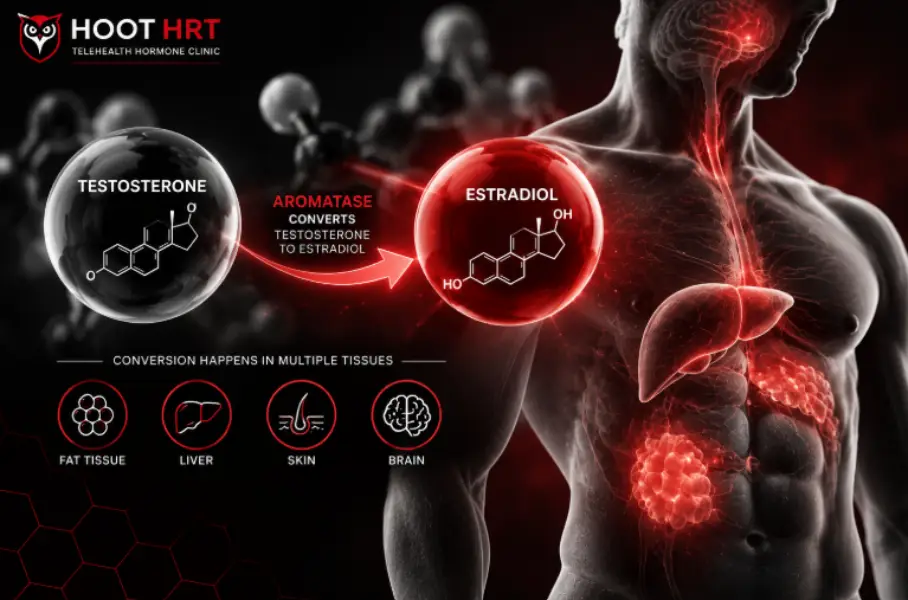
Estradiol rises when aromatase activity increases. The enzyme converts more testosterone into estradiol, and the balance shifts. Understanding what drives that conversion is useful because some of the factors are modifiable and some are not.
Body fat is the biggest driver. Aromatase is heavily concentrated in fat tissue, particularly visceral fat stored around the abdominal organs. Men with higher body fat percentages tend to convert testosterone to estradiol at higher rates, which is why estradiol and waist circumference often move together. Losing body fat does not just improve testosterone levels directly. It reduces aromatase activity and can meaningfully change the testosterone-to-estradiol ratio without any medication.
Age. Aromatase activity increases as men get older, even when body weight stays relatively stable. This is part of why estradiol management becomes a more active clinical consideration in men over 40.
Alcohol. The liver is responsible for clearing excess estradiol from circulation. Heavy or regular alcohol use impairs liver function and reduces the body’s ability to process and excrete estradiol efficiently. The effect is meaningful even at moderate consumption levels over time.
Certain medications and supplements. Some common medications, including certain antifungals, blood pressure medications, and even some supplements marketed for men’s health, can influence aromatase activity or interfere with estrogen clearance. This is worth reviewing with a provider whenever estradiol comes back unexpectedly elevated.
Genetic variation in aromatase activity. Some men are simply faster converters than others. Two men with identical body composition can have significantly different estradiol levels based on how actively their individual aromatase enzyme operates. This does not show up on a standard hormone panel, but it explains why protocols that work well for one man may need meaningful adjustment for another.
The practical takeaway is that elevated estradiol in men usually has a traceable cause. Finding it is more useful than suppressing the number before understanding what is driving it.
High estradiol in men produces a recognizable set of symptoms, though none of them are exclusive to estrogen imbalance. That distinction matters, and we will come back to it.
Water retention. Estradiol promotes fluid retention. Men with elevated estradiol often notice puffiness in the face, hands, and ankles. Rings that fit yesterday do not fit today. Shoes feel tight by the end of the day. It is subtle at first and easy to attribute to diet or travel, but it tends to be persistent.
Gynecomastia. This refers to the development of actual breast tissue, not just chest fat, in men. It presents as a firm, sometimes tender mass behind the nipple rather than general softness across the chest. Nipple sensitivity is often the first sign before visible tissue develops. Gynecomastia that has been present for an extended period does not reliably resolve with estradiol management alone, which is one reason early identification matters.
Mood changes. Irritability, emotional sensitivity, and a short temper are commonly reported by men with elevated estradiol. Some describe it as feeling reactive in a way that is unlike them. Others report anxiety or a low-grade restlessness that does not track with anything happening in their lives.
Erectile dysfunction and reduced libido. When estradiol runs high relative to testosterone, the testosterone-to-estradiol ratio shifts in a direction that impairs sexual function. Men notice reduced interest in sex and difficulty achieving or maintaining erections, even when testosterone levels look adequate on paper.
Abdominal fat that will not move. High estradiol promotes fat storage, particularly around the midsection. Men who are training consistently and eating well but cannot shift abdominal weight sometimes find that estradiol imbalance is a contributing factor.
The important caveat here is that every symptom on this list is also produced by low testosterone, thyroid dysfunction, poor sleep, chronic stress, and several other conditions. A symptom alone is not a diagnosis. This is why evaluating estradiol alongside the full hormone picture is the more clinically sound approach. Men experiencing these symptoms alongside what looks like low testosterone deserve a complete evaluation, not a single-marker response.
This is the section most men never read because most content about estrogen in men focuses almost entirely on high estradiol. Low estradiol does not get the same attention. It should, and the reason it should is directly connected to what happens when estradiol gets suppressed too aggressively.
Joint pain and stiffness. Estradiol plays a meaningful role in joint lubrication and connective tissue health. Men with crashed estradiol often describe joint pain that appears suddenly and does not have an obvious mechanical explanation. Knees, hips, shoulders, and wrists are commonly affected. The pain tends to be diffuse rather than localized to a specific injury site.
Depression and emotional flatness. Low estradiol in men is associated with a particular quality of mood disruption: not agitated or anxious, but flat. Men describe losing interest in things they previously cared about, feeling emotionally blunted, and finding little that motivates them. It is often misread as a testosterone problem or attributed to life circumstances.
Absent libido. Low estradiol produces a loss of sexual interest that is qualitatively different from the libido reduction associated with high estradiol. Men describe it as a complete absence of drive rather than a diminished one. It does not respond to testosterone optimization alone because the problem is not testosterone.
Brain fog and poor concentration. Estradiol supports cognitive function in men. When levels drop too low, the effects show up as difficulty thinking clearly, slower processing, and a general sense of mental heaviness that persists regardless of sleep quality or caffeine intake.
Accelerated bone loss. This is the consequence that takes the longest to notice and does the most lasting damage. Men with chronically low estradiol lose bone mineral density at a rate that becomes clinically significant over months to years. By the time it is identified on a DEXA scan, meaningful loss has already occurred.
The most common cause of low estradiol in otherwise healthy men is overly aggressive aromatase inhibitor use. That is not a fringe event. It is a predictable consequence of a specific prescribing pattern, and it is underreported because men often do not connect their new symptoms to a medication they were told was managing their estrogen.
This is where most conversations about estradiol go sideways. A man gets his labs back, sees a number, compares it to the reference range printed on the report, and draws a conclusion. That conclusion is often wrong, not because the number is wrong, but because the reference range was not built for him.
Standard laboratory reference ranges for estradiol in men are typically listed somewhere between 10 and 40 pg/mL, though the exact numbers vary depending on the laboratory and the testing method used. Those ranges were established using population samples that included sedentary men, older men, men with varying degrees of metabolic health, and men not on any hormone therapy. They represent what is statistically common in a broad population, not what is optimal for a specific individual.
A man who is active, lean, and in good metabolic health may feel and function best at a different point in that range than a man who is sedentary and carrying excess body fat. Two men with estradiol at 38 pg/mL can have completely different clinical pictures depending on where their testosterone sits, what their SHBG looks like, how they feel, and what their body composition tells the rest of the story.
The testosterone-to-estradiol ratio is one of the more clinically meaningful ways to interpret estradiol in men. When testosterone is in an optimal range and estradiol is proportional to it, the hormonal relationship tends to support good function. When estradiol is disproportionately elevated relative to testosterone, even if the absolute number looks acceptable on paper, the ratio is telling a different story. Conversely, when testosterone is elevated and estradiol is artificially suppressed, the ratio is out of balance in a direction that carries its own consequences.
Looking at estradiol as a standalone number and comparing it to a population-derived reference range answers a limited question. Looking at it alongside testosterone, SHBG, symptoms, body composition, and history answers the question that actually matters. This is a central point in the distinction between normal lab results and optimal hormone health, a gap that standard panels routinely fail to close.
Most men getting their estradiol evaluated are being given a test that was not designed for them, and an inaccurate test can lead directly to an inaccurate treatment decision.
The default estradiol assay in most labs is called an immunoassay. It works by using antibodies to estimate estradiol concentration in the blood. Immunoassays were developed and validated primarily for women, whose estradiol levels run considerably higher than men’s. At the lower concentrations typical in men, generally between 10 and 60 pg/mL, standard immunoassays are less precise. They can cross-react with structurally similar molecules and produce readings that overestimate actual estradiol levels. A man whose estradiol reads at 52 pg/mL on a standard immunoassay may have an actual level that is meaningfully lower when measured correctly.
The accurate method for men is liquid chromatography with tandem mass spectrometry, referred to as LC-MS/MS, or sometimes called the sensitive or ultrasensitive estradiol assay. This method directly identifies and quantifies estradiol molecules rather than estimating them through antibody binding. It is considerably more precise at the concentrations men occupy and is less susceptible to interference from other compounds.
The clinical implication is direct. If a man’s estradiol result is being used to make a treatment decision, whether to start an aromatase inhibitor, adjust a dose, or continue monitoring, the accuracy of that test determines the quality of that decision. A falsely elevated result from a standard immunoassay can trigger intervention that is not warranted. That intervention then suppresses estradiol that was not actually elevated, and the man ends up with crashed estradiol from a problem that did not exist in the first place.
What to ask for specifically: the sensitive estradiol assay, the ultrasensitive estradiol assay, or LC-MS/MS estradiol. At Hoot HRT, this is run as standard on every male hormone panel. Not an upgrade. Not an add-on. Just what accurate estradiol monitoring in men requires.
Aromatase inhibitors, most commonly anastrozole, block the enzyme that converts testosterone to estradiol. They have a legitimate clinical role. When a man has genuinely elevated estradiol, confirmed through accurate testing, producing symptoms that are consistent with estrogen excess, a low-dose aromatase inhibitor under close monitoring is a reasonable tool. That is not what this section is about.
This section is about what happens when that same medication gets prescribed as a reflex. Lab comes back with estradiol at 40 or 45. Provider writes the prescription. No conversation about whether the symptoms actually match. No question about which test was run or whether it is accurate for men at those concentrations. No monitoring schedule. Just suppress the number.
That is not standard of care. It is a protocol standing in for clinical judgment, and the harm it causes is predictable and documented.
Men whose estradiol is driven too low by overly aggressive suppression experience a specific and severe deterioration. Joints that were not a problem become painful, sometimes suddenly. Mood does not stabilize. It collapses into a flat, motivationless state that does not respond to anything. Libido, which was supposed to improve, disappears. Bone mineral density loss begins accumulating silently in the background. Some men report that their quality of life on the aromatase inhibitor is worse than it was before they started any treatment at all.
The error compounds itself because the symptoms of crashed estradiol are not obviously connected to estrogen. Men experiencing this do not typically think: my estradiol is too low. They think: something is wrong and nobody can explain it. By the time the picture becomes clear, some degree of real physiological damage may already have occurred.
The right response to elevated estradiol is not automatic suppression. It is a clinical conversation that works through what is actually driving the elevation, whether the test result is accurate, whether the symptoms are consistent with estrogen excess or better explained by something else, and whether a protocol adjustment or a lifestyle change resolves it before reaching for a prescription. A clinician who skips that conversation is not following standard of care. They are following a number.

A complete estradiol evaluation is not a single number on a lab report. It is a clinical picture built from several inputs, and the picture is only useful when all the inputs are present.
At Hoot HRT, estradiol is assessed alongside total testosterone, free testosterone, and SHBG using the sensitive LC-MS/MS assay as standard on every male hormone panel. No single marker is interpreted in isolation, because no single marker tells the complete story. A man with estradiol at 44 pg/mL and testosterone at 900 ng/dL with no symptoms is in a different clinical situation than a man with the same estradiol reading and testosterone at 380 ng/dL reporting mood changes and water retention. The number is the same. The clinical picture is not.
The evaluation also includes a direct conversation about symptoms, timeline, body composition, lifestyle, and history. How long have the symptoms been present. What has changed recently. What has already been tried. Whether the symptoms are actually consistent with estradiol imbalance or more likely explained by something else. These are questions that a panel of labs cannot answer on its own.
Decisions about whether to adjust a protocol, recommend lifestyle changes, or add any form of estrogen management are made from that complete picture. That means some men with estradiol in a range that would trigger automatic treatment elsewhere leave with no prescription and a different conversation. It also means some men who were told their estrogen was fine get a more thorough look at why they are still not feeling right.
Understanding how the clinical process works before a first appointment helps men come in with clearer expectations and more useful information to share.
If you have had labs come back with an estradiol number that raises questions, or you have been managing symptoms that nobody has been able to explain through a complete hormone picture, that is the conversation worth having.
At Hoot HRT, estradiol is evaluated as part of a full hormone panel alongside testosterone and SHBG before anything is recommended. The sensitive assay is standard. Cash-pay, no contracts, telehealth across Texas.
Schedule your evaluation at Hoot HRT and find out where you actually stand.
Medically Reviewed by: Joe Hamm, PA-C, Co-Founder, Hoot HRT
Published by: Hoot HRT
DISCLAIMER
This article is for educational purposes only and does not constitute medical advice. It is not a substitute for evaluation, diagnosis, or treatment by a licensed healthcare provider. Individual results and clinical circumstances vary. Speak with a qualified clinician before making any decisions about hormone therapy or any treatment discussed in this article.
SOURCES