

Co-Founder, Hoot HRT
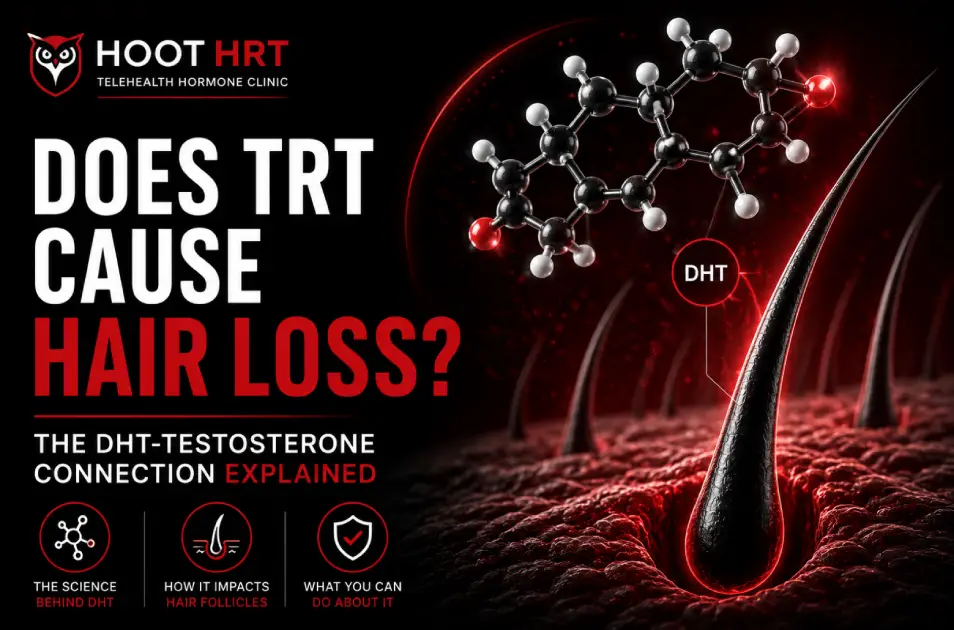
Testosterone replacement therapy may accelerate hair loss in men who are already genetically predisposed to androgenic alopecia, but it is not a cause of hair loss in men without that predisposition. The mechanism runs through DHT (dihydrotestosterone), a hormone produced when the enzyme 5-alpha reductase converts testosterone into a more potent form.
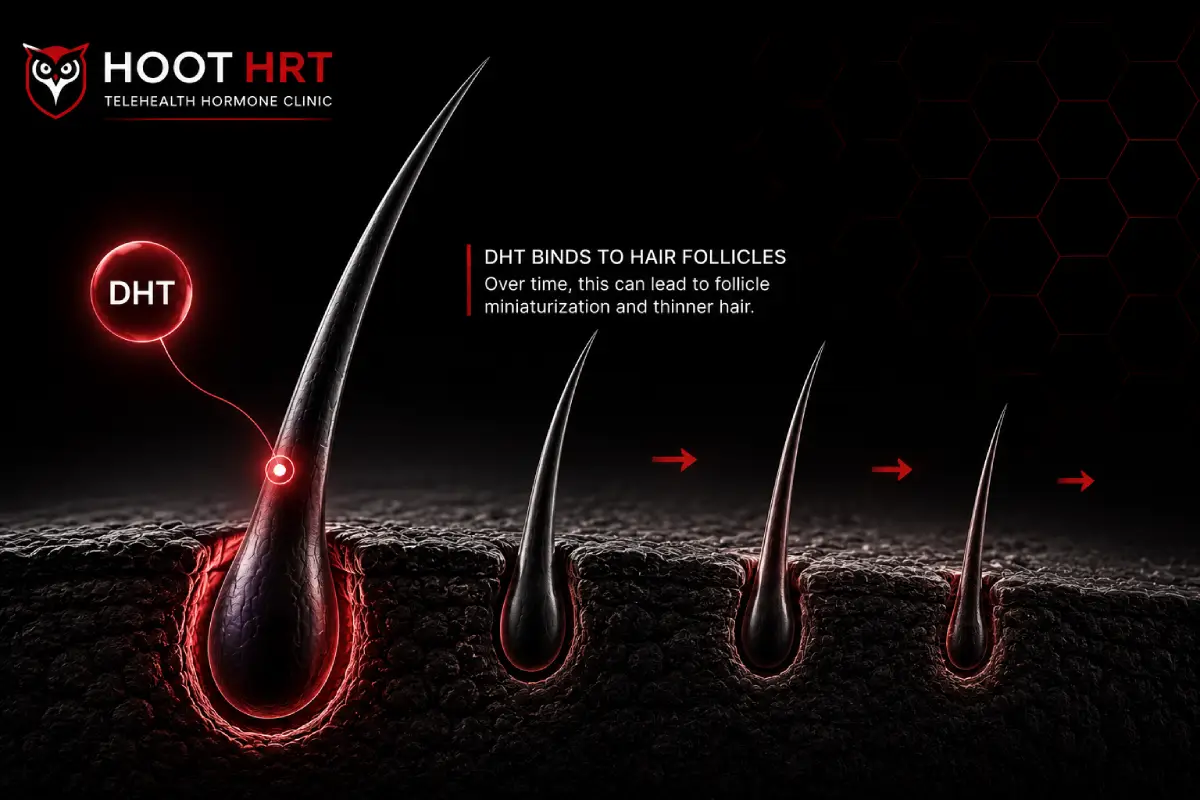
In men with genetically sensitive hair follicles, DHT gradually miniaturizes those follicles over time, producing the thinning pattern known as androgenic alopecia.
TRT raises testosterone levels, which may increase available DHT. Whether that translates to noticeable hair loss depends primarily on your genetics, not on the therapy itself. At Hoot HRT, hair loss risk is part of the clinical evaluation conversation before any treatment decision is made.
Hair loss is one of the first concerns men raise when they start researching testosterone replacement therapy. It’s a reasonable question, and it tends to get answered with a frustrating amount of vagueness.
The actual answer is more specific than most sources let on. TRT does not cause hair loss in men who are not genetically predisposed to it. In predisposed men, TRT may accelerate a process that was likely going to unfold anyway. The mechanism, the timeline, and what options exist all depend on factors worth understanding before any decisions are made.
This is where the question of whether TRT causes hair loss and the role of DHT converge. The answer has less to do with testosterone than with a single enzyme, a single conversion, and whether your hair follicles are genetically wired to respond to what that conversion produces.
DHT stands for dihydrotestosterone. It’s an androgen, meaning it belongs to the same hormonal family as testosterone, and it’s considerably more potent at the receptor level.
DHT is produced when an enzyme called 5-alpha reductase converts free testosterone. This enzyme is present throughout the body but is particularly concentrated in the skin, scalp, liver, and prostate. Once formed, DHT binds to androgen receptors with roughly two to three times the binding affinity of testosterone itself.
DHT plays well-documented roles in male development, particularly during puberty, and it continues to circulate in adult men throughout their lives. It is not a rogue hormone. The issue arises when its effects intersect with genetically sensitive tissue, specifically scalp hair follicles.
Androgenic alopecia is the clinical term for male pattern baldness. It affects a large portion of men to varying degrees by midlife, and DHT is the primary hormonal driver.
In men with a genetic sensitivity to DHT, the androgen receptors inside scalp hair follicles are particularly reactive. When DHT binds to those receptors repeatedly over time, it shortens the anagen (growth) phase of the hair cycle and gradually miniaturizes the follicle itself. Miniaturized follicles produce progressively finer, shorter hairs until they eventually stop producing hair altogether.
The pattern typically begins at the temples and crown and follows predictable progression pathways classified clinically using the Norwood-Hamilton scale.
Here is the part that gets overlooked in most discussions. DHT does not trigger this process universally. A man with elevated DHT but non-sensitive follicles may keep a full head of hair. A man with normal DHT but highly reactive follicles may experience significant thinning. The sensitivity is genetic, inherited primarily through variants in the androgen receptor gene on the X chromosome. Absolute DHT levels matter less than what the follicles do with them.

When TRT raises testosterone levels, 5-alpha reductase converts a portion of that testosterone to DHT. So yes, TRT can increase circulating DHT. The clinical question is whether that increase produces meaningful hair loss consequences.
Research supports the position that androgen receptor sensitivity in follicles, not absolute androgen levels, is the primary driver of androgenic alopecia. Kaufman KD’s review published in Molecular and Cellular Endocrinology (2002) outlined the established mechanism: DHT acts on genetically predisposed follicles, not on all follicles equally. Men without the underlying genetic predisposition do not show a clinically meaningful pattern of hair loss from elevated DHT.
What TRT may do, in men who were already going to develop androgenic alopecia, is move the timeline forward. Hair that might have thinned noticeably at 52 may begin thinning at 43. The underlying trajectory was likely the same. The pace changed.
Men already showing early signs of androgenic alopecia before starting TRT represent the most clinically relevant risk group. For men with no personal thinning and no family history of male pattern baldness, the risk of TRT initiating androgenic alopecia is considered low based on the current evidence base.
The higher-risk profile is fairly well-defined. Men already showing thinning at the temples or crown before starting TRT are most likely to see acceleration. Men with a strong family history of androgenic alopecia on either side carry a meaningfully elevated genetic risk.
Men with no visible thinning and no family history fall into a lower-risk category. That is not zero risk. It means the mechanism that would drive hair loss has no clear genetic entry point to accelerate through elevated DHT.
For men in the higher-risk group, TRT is not automatically off the table. It becomes a risk-benefit conversation. The clinical improvements many patients report on testosterone therapy, including improved energy, mood stability, body composition, and libido, may outweigh the concern of accelerated hair thinning. For some men, that cosmetic concern is significant enough to shape the treatment approach. Both are valid positions. The point is to reach that decision with accurate information, not to discover the trade-off retroactively.
This is a clinically relevant question, and the research suggests the answer is yes, at least to a degree.
Topical testosterone, applied as a gel or cream to the skin, passes through tissue that contains relatively high concentrations of 5-alpha reductase before entering systemic circulation. A proportion of the applied dose may be converted to DHT locally before it reaches the bloodstream. Some research indicates this produces a higher DHT-to-testosterone ratio compared to intramuscular injection, where testosterone enters general circulation more directly.
This does not make topical TRT clinically inappropriate. For men with a documented concern about DHT and its potential effects on hair, however, delivery method is a variable worth discussing with a provider. It is one of several adjustable factors in a well-managed testosterone protocol.
Several clinical strategies may help manage DHT levels or reduce their effect on hair follicles in men on testosterone replacement therapy. None of them are without trade-offs, and all require a clinical conversation before use.
Finasteride and dutasteride both work by blocking the enzyme that converts testosterone to DHT. Finasteride at 1mg (Propecia) is FDA-approved for androgenic alopecia and blocks the type 2 isoform of 5-alpha reductase. Dutasteride blocks both type 1 and type 2 isoforms, producing a more complete reduction in circulating DHT, though it is not FDA-approved specifically for hair loss.
Both medications carry a documented side effect profile that must be discussed openly before prescribing. A subset of users report reduced libido, changes in erectile function, and ejaculatory changes. A smaller subset has reported persistent side effects after discontinuation, described in the literature under the term Post-Finasteride Syndrome. The prevalence and mechanism of persistent effects remain subjects of ongoing research, but the reports exist and patients deserve to know about them before starting.
Minoxidil does not affect DHT. It works through a separate mechanism, extending the hair growth phase and increasing blood flow to follicles. It is available over the counter in 2% and 5% topical concentrations, and clinical evidence for its use in androgenic alopecia is well-established. It does not address the hormonal driver but may slow visible progression independently and is often used alongside other approaches.
Topical finasteride formulations, compounded for scalp application, have been the subject of research suggesting they may reduce scalp DHT with lower systemic absorption compared to the oral form. The evidence base here is more limited than for oral finasteride, and this approach is best characterized as emerging rather than definitively established. It represents a potentially lower-systemic-exposure option for some patients and is worth raising with a provider if the side effect profile of oral finasteride is a concern.
As discussed above, switching from topical to injectable testosterone may reduce DHT conversion for some patients. For men already on TRT who notice hair changes and want to address them without adding new medications, revisiting delivery method is a straightforward clinical variable to raise with a provider.
The right time to discuss hair loss risk is before testosterone replacement therapy begins. Once significant follicle miniaturization has occurred, reversal is not a realistic expectation with any currently available intervention.
At Hoot HRT, personal and family history of androgenic alopecia is part of the standard intake process. Men with a documented risk profile are informed about what TRT may and may not do, what monitoring options exist, and what adjunctive approaches are available if that conversation leads there. No treatment is recommended without this foundation.
This is not a reason to avoid TRT if it’s clinically appropriate for you. It is a reason to make the decision with complete information rather than finding out later what the conversation should have covered.
Hair loss is a real concern, and it deserves a real clinical conversation before any prescription is written.
If you’re weighing testosterone replacement therapy and want to understand what it may mean for your specific history, an evaluation at Hoot HRT starts with the complete picture. That includes your full hormone panel, your symptom history, your family history of hair loss, and a direct conversation about risk and your options.
Schedule your evaluation at Hoot HRT. We’re a cash-pay telehealth hormone clinic serving men in San Antonio and across Texas. Clear pricing. No pressure. Just the clinical information you need to decide.
No. TRT does not cause hair loss in men without a genetic predisposition to androgenic alopecia. In men who carry that predisposition, TRT may accelerate existing hair loss by increasing available DHT, but it does not create the condition where none existed. At Hoot HRT, personal and family hair loss history is reviewed as part of every male hormone evaluation before any treatment is recommended.
Finasteride is sometimes used alongside testosterone replacement therapy to manage DHT levels in men with androgenic alopecia concerns. It is not appropriate for every patient, and it carries a documented side effect profile that should be reviewed carefully before starting. At Hoot HRT, this is a clinical conversation, not a default add-on to every protocol.
In most cases, no. Hair loss associated with follicle miniaturization from DHT is generally not reversible, whether testosterone therapy continues or stops. Discontinuing TRT may slow further DHT-driven progression in some men, but meaningful regrowth of miniaturized follicles is not typically expected. This is one reason the hair loss conversation belongs before starting therapy, not after noticing changes.
Research suggests transdermal testosterone preparations may produce a higher DHT-to-testosterone ratio than intramuscular injections, because the skin contains higher concentrations of 5-alpha reductase. For men with a documented hair loss concern, injectable testosterone may represent a more favorable delivery option. This is a clinical variable worth raising with your provider at Hoot HRT.
Androgenic alopecia is the clinical term for male pattern baldness. It is driven by DHT binding to androgen receptors in genetically sensitive scalp hair follicles, gradually miniaturizing those follicles over time. It typically begins at the temples and crown and is classified using the Norwood-Hamilton scale. It is primarily a genetic condition, not a direct consequence of testosterone levels alone.
If you have a genetic predisposition to androgenic alopecia, intervening before significant miniaturization has occurred is the most effective approach. Finasteride and minoxidil are the most clinically established options for slowing progression. Some men choose to begin one or both before starting TRT as a proactive measure. This depends on your current hair status, family history, and tolerance for each medication’s risk profile. Hoot HRT can help evaluate your situation across Texas.
No. DHT causes hair loss only in men with genetically sensitive androgen receptors in their scalp hair follicles. Men without that sensitivity can carry elevated DHT and retain their hair. The genetic predisposition, primarily inherited through variants in the androgen receptor gene, determines whether DHT miniaturizes follicles. This is why two men with identical hormone levels can have completely different hair outcomes.
Not in a direct or predictable way. DHT-driven hair loss in predisposed men is more closely tied to follicle sensitivity and cumulative DHT exposure over time than to any single dose level. That said, keeping testosterone within a clinically appropriate range rather than running levels artificially high is sound practice for multiple reasons, including DHT management. At Hoot HRT in San Antonio, dosing decisions are based on your full clinical picture, not a number alone.
DISCLAIMER
This article is for educational purposes only and does not constitute medical advice. It is not a substitute for evaluation, diagnosis, or treatment by a licensed healthcare provider. Individual results and clinical circumstances vary. Speak with a qualified clinician before making any decisions about hormone therapy, hair loss treatment, or medications discussed in this article.
SOURCES