

Medical Director, Hoot HRT
Low testosterone and erectile dysfunction are related, but testosterone is rarely the direct cause of ED on its own. Most men with ED have vascular or circulatory issues as the primary driver. However, testosterone plays a real role in the biology of erections, and when levels fall severely below 200 ng/dL, hormonal deficiency can become the dominant cause. The two conditions also share risk factors, including obesity, diabetes, and cardiovascular disease, which is why they appear together so often.
Most men who search this question already have a sense that something is off. Maybe they have been using a PDE5 inhibitor with less success than before. Maybe their sex drive has dropped, their erections are softer, and they are not sure whether the problem is hormonal, vascular, or somewhere in between. The honest answer is that it is usually both, and the way those two things interact is something most general health websites do not explain well.
The short answer is yes, but only under specific conditions. Testosterone is not the primary driver of erectile function for most men. Blood flow is. The vascular system, particularly the arterial supply to penile smooth muscle tissue, is what makes erections mechanically possible, and that system can fail independently of hormone levels.
What testosterone does control more directly is libido the motivation to pursue sexual activity. When testosterone falls significantly, desire drops first. That drop in desire then feeds into erection difficulty indirectly, because arousal and desire are part of the biological cascade that initiates an erection. Without them, the whole process is harder to start.
The clinical picture changes when testosterone falls into severe hypogonadism, typically below about 200 to 230 ng/dL. At those levels, testosterone’s direct effects on penile smooth muscle tissue and vascular signaling become clinically significant. The relationship moves from indirect to direct. That distinction is why the question does not have a simple yes or no answer: it depends entirely on how low the testosterone actually is and what else is going on with the man’s vascular health.
When a man in his forties or fifties has both low testosterone and erectile dysfunction, the most common reason is not that one caused the other. It is that they share the same underlying root causes.
Obesity, type 2 diabetes, cardiovascular disease, metabolic syndrome, and high blood pressure all suppress testosterone production while simultaneously damaging the vascular endothelium and reducing arterial blood flow. A man who has accumulated those metabolic risk factors over a decade will often arrive at a clinic with both low T and ED at the same time, even though neither one directly caused the other.
This matters clinically because treating only the testosterone without addressing the vascular side will not fully resolve the erectile problem. And treating only the vascular side without identifying the hormonal deficiency will leave a significant factor unaddressed. Research from the Massachusetts Male Aging Study found that roughly 52 percent of men between ages 40 and 70 experience some degree of erectile dysfunction (Feldman et al., 1994). Among men with ED, studies suggest approximately one in three also has low testosterone. The overlap is common. The causation is more complicated.
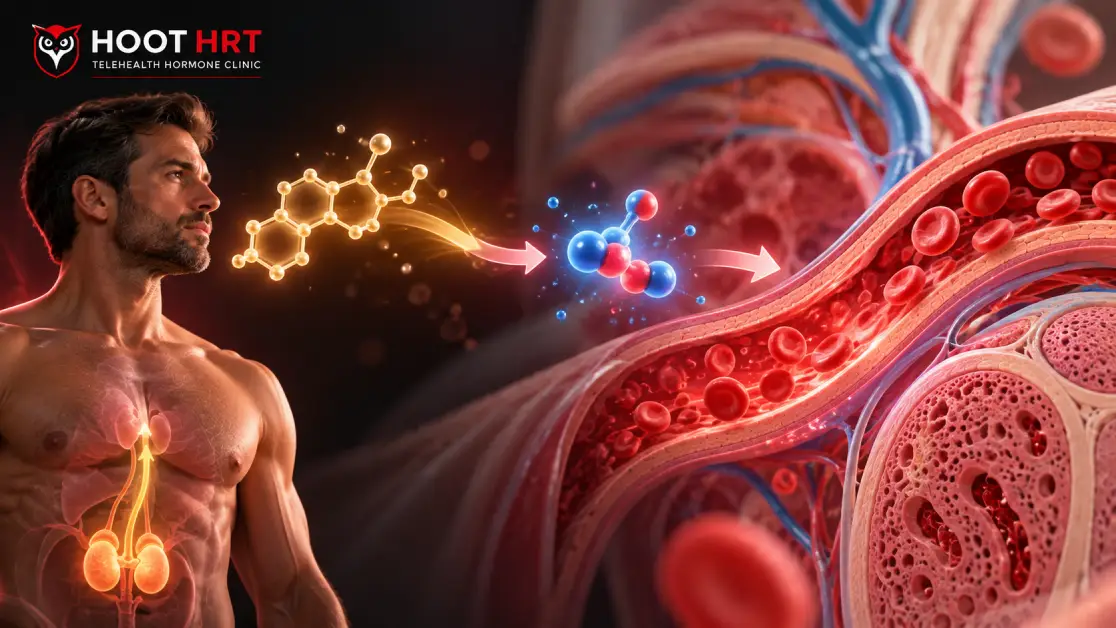
This is where the science gets specific, and where most health articles fall short. An erection requires a precise sequence of events. Sexual stimulation triggers the release of nitric oxide in the endothelium of penile arteries. Nitric oxide causes smooth muscle in the penile tissue to relax, allowing arterial blood to flow in and fill the corpus cavernosum. That filling creates the hydraulic pressure of an erection.
Testosterone is upstream in this process because it regulates the expression of eNOS, endothelial nitric oxide synthase, the enzyme responsible for producing nitric oxide in the penile vasculature. When testosterone is adequate, eNOS activity is appropriately maintained and the nitric oxide cascade functions normally. When testosterone falls significantly, eNOS expression is reduced, nitric oxide production becomes less efficient, and the entire downstream process is compromised even when arterial anatomy is structurally intact.
This is why some men notice softer erections even before other symptoms of low T appear. The vascular mechanism is sensitive to hormonal input, and the eNOS pathway is one of the clearest links between testosterone and erectile function in the published literature (Rajfer, 2000). PDE5 inhibitors like sildenafil and tadalafil work by blocking the enzyme that breaks down cGMP, a signaling molecule that depends on adequate nitric oxide for its production. When eNOS activity is already reduced by low testosterone, PDE5 inhibitors have a weaker biological substrate to work on. The drug is amplifying a signal that is already faint.
Men who report that Viagra has stopped working as well as it used to should have their testosterone checked. That loss of effectiveness is a recognized clinical signal of underlying hormonal deficiency, and clinical data suggest that adding testosterone therapy to PDE5 inhibitor treatment substantially improves outcomes in men with both conditions. A study by Isidori and colleagues published in Clinical Endocrinology (2005) found that testosterone replacement improved erectile function significantly in hypogonadal men, particularly when combined with existing ED treatment.
Most of the time, low testosterone is a contributing factor in erectile dysfunction, not the primary cause. There are three clinical scenarios where that changes, and where testosterone is the dominant driver.
The first is severe primary hypogonadism. When total testosterone falls below approximately 200 ng/dL, the direct effects on penile smooth muscle and eNOS activity become clinically dominant. At these levels, treating the hormonal deficiency is the primary intervention, not an adjunct.
The second is secondary hypogonadism with pituitary or hypothalamic dysfunction. In secondary hypogonadism, the problem is not in the testes but in the signaling chain from the brain. LH and FSH, the hormones that signal the testes to produce testosterone, are low or inappropriately normal when testosterone is also low. This pattern points to a hypothalamic or pituitary issue, and the resulting testosterone deficiency tends to be more complete and more directly tied to sexual dysfunction because the entire hormonal axis is disrupted.
The third scenario involves post-procedural hormonal deficiency, including men who have undergone prostate surgery, radiation, or orchiectomy. In these cases, testosterone production is significantly or completely impaired by the procedure, and the resulting erectile dysfunction has a clear hormonal mechanism that responds to hormonal treatment.
Outside of these three scenarios, most men with low testosterone and erectile dysfunction have a mixed picture where both hormone levels and vascular function contribute.

The most useful clinical clue most men overlook is morning erections. Nocturnal penile tumescence, the spontaneous erections that occur during REM sleep, are driven by a neurological and hormonal mechanism that operates independently of psychological state. A man who still has firm morning erections but struggles during sex is more likely dealing with psychological factors or performance anxiety than with vascular or hormonal disease. A man who has lost morning erections entirely, particularly if they were previously consistent, is more likely dealing with a physiological cause, either vascular dysfunction, significant hormonal deficiency, or both.
That distinction matters because it helps determine which investigation to prioritize first. It is not a diagnosis, but it is a meaningful clinical signal that a proper evaluation can use.
A complete hormone evaluation for a man presenting with erectile dysfunction and suspected low testosterone goes considerably beyond a single testosterone reading. It includes total testosterone drawn in the morning, between 7 and 10 a.m., because testosterone follows a diurnal pattern that causes afternoon values to be meaningfully lower than morning values. The Endocrine Society recommends confirming low testosterone on at least two separate mornings before initiating treatment.
It also includes free testosterone, LH and FSH to identify whether the problem is in the testes or in the signaling cascade above them, estradiol using the sensitive LC-MS/SS assay rather than the standard immunoassay (which was not designed for the lower concentrations found in men), and a basic metabolic panel. Getting a testosterone level drawn at 3 p.m. during a general wellness visit and using that as the basis for a clinical decision is one of the most common diagnostic errors in outpatient medicine. The timing matters.
If your testosterone is low and your current ED treatment has lost effectiveness, the clinical path forward is to address both conditions, not just one. For men with confirmed hypogonadism and erectile dysfunction, combined treatment generally produces better outcomes than treating either condition in isolation.
Hoot HRT manages testosterone therapy for men with confirmed hypogonadal symptoms and appropriate lab findings, and we take an evidence-based approach to both the testing and the treatment protocol. If you are dealing with erectile difficulties alongside suspected hormonal issues, an erectile dysfunction evaluation is the right starting point, because it identifies which factor is primary and in what proportion. To understand how our evaluation process works before you book, that page walks through what to expect from the first consultation through ongoing monitoring.
Conclusion
If you have been dealing with erectile difficulties and your testosterone has never been checked, that is the most important unanswered question in your situation. One of the most common oversights in managing erectile dysfunction is treating the vascular side without ever confirming whether the hormonal side is a factor. Hoot HRT is a cash-pay telehealth clinic in Texas that provides complete hormone evaluations for men, including the full lab panel, morning draw protocol, and clinical interpretation based on your symptoms, not just a reference range.
Schedule your evaluation and get a clear picture of what is actually driving your symptoms.
Medically Reviewed by: Joe Hamm, PA-C, Co-Founder, Hoot HRT
Disclaimer
This article is for informational purposes only and does not constitute medical advice, diagnosis, or treatment. Individual results vary. Consult a qualified healthcare provider before making any decisions about hormone therapy or erectile dysfunction treatment.
Sources
Feldman HA, Goldstein I, Hatzichristou DG, Krane RJ, McKinlay JB. Impotence and its medical and psychosocial correlates: results of the Massachusetts Male Aging Study. Journal of Urology. 1994;151(1):54-61.
Isidori AM, Giannetta E, Gianfrilli D, et al. Effects of testosterone on sexual function in men: results of a meta-analysis. Clinical Endocrinology (Oxford). 2005;63(4):381-394.
Rajfer J. Relationship between testosterone and erectile dysfunction. Reviews in Urology. 2000;2(2):122-128.
Low testosterone can contribute to erectile dysfunction, but it is rarely the direct or sole cause for most men. For the majority of men with ED, the primary driver is vascular disease that reduces arterial blood flow to penile tissue. Testosterone becomes a more direct cause when levels fall into severe hypogonadism, generally below 200 ng/dL, where its effects on the nitric oxide signaling pathway are clinically significant. A complete hormone evaluation at a clinic like Hoot HRT in Texas can clarify which factor is dominant in your specific situation.
Yes. Many men with clinically low testosterone continue to have erections, though they may notice reduced firmness, lower spontaneous frequency, or a drop in sex drive. This is because erection mechanics depend primarily on blood flow and vascular function, which can remain intact even when testosterone is below optimal levels. The impact of low T on erectile function is most pronounced when testosterone falls severely or when hormonal deficiency compounds an existing vascular issue.
Testosterone is not the primary mechanism of erection, but it plays a meaningful supporting role. It regulates the expression of eNOS, the enzyme that produces nitric oxide in penile vascular tissue. Nitric oxide is what triggers smooth muscle relaxation and arterial blood flow into the penis. Without adequate testosterone, eNOS activity is reduced and the nitric oxide cascade is less efficient, which is why severe testosterone deficiency can produce softer erections even when blood flow is structurally normal.
Clinical literature suggests that direct impairment of erectile function from testosterone deficiency becomes more pronounced below approximately 200 to 230 ng/dL. Above that threshold, low testosterone typically affects libido and sexual motivation more than the mechanical ability to achieve an erection. Below it, testosterone’s effects on the eNOS pathway and penile smooth muscle tissue become clinically significant. This is one reason why two men with “low” testosterone at different absolute values can have very different erectile function.
Partial or incomplete erections are often related to reduced nitric oxide activity in the penile vasculature, which can stem from either vascular endothelial dysfunction or reduced testosterone driving eNOS expression. When testosterone is low, the nitric oxide signaling cascade that drives full smooth muscle relaxation is less robust, meaning the hydraulic filling process may be incomplete. If your erections have consistently shifted from firm to partial, a complete hormonal and vascular evaluation is the appropriate next step rather than assuming the cause without testing.
Testosterone therapy, when properly monitored, does not cause erectile dysfunction. In some men starting testosterone therapy, estradiol levels rise as the body converts testosterone to estrogen, and elevated estradiol can temporarily affect erection quality if it goes unmonitored. This is why proper lab follow-up is part of every managed testosterone protocol. At Hoot HRT, monitoring includes estradiol using the sensitive assay appropriate for men so that imbalances are identified and addressed early.
Yes, particularly if you have not had testosterone levels drawn or if your last reading was not a fasting morning draw between 7 and 10 a.m. A testosterone value taken in the afternoon can be meaningfully lower than a true morning baseline, which leads to misinterpretation. The Endocrine Society recommends confirming low testosterone on two separate morning draws before clinical decisions are made. If you have erectile dysfunction and your hormone levels have never been formally evaluated, that evaluation is an important part of understanding your full clinical picture. Hoot HRT in San Antonio provides complete hormone panels for men in Texas through a fully telehealth process.
The loss of morning erections, also called nocturnal penile tumescence, can be a signal of either significant hormonal deficiency or vascular dysfunction, and is considered a meaningful clinical clue in distinguishing physiological from psychological erectile dysfunction. Men who consistently lose morning erections but previously had them regularly should have both testosterone and vascular health evaluated. It is not a diagnosis on its own, but it shifts the evaluation toward a physical cause and away from purely psychological factors.