

Co-Founder, Hoot HRT
Yes, estrogen loss during menopause is directly linked to belly fat. But not necessarily because it makes you eat more.
When estrogen declines, fat that used to store in your hips and thighs starts storing around your abdomen instead.
The fat is redistributing, not simply multiplying.
Research from the SWAN study reported an approximate annual increase in visceral abdominal fat during the menopausal transition. This highlights how body fat distribution can change even without substantial overall weight gain.
Estrogen influences fat storage in the hips and thighs through estrogen receptor alpha (ERα).
When ERα signaling weakens at menopause, abdominal fat storage becomes more prominent.
Visceral fat surrounds internal organs and behaves differently from the subcutaneous fat you can pinch.
Fat redistribution often begins during perimenopause, before the final menstrual period.
Hormone therapy started around menopause may help limit increases in abdominal fat, although results vary.
Hoot HRT offers telehealth hormone evaluations for women across San Antonio, Austin, and Texas.
Considering hormone therapy? Hoot HRT provides personalized telehealth hormone evaluations to help women understand their symptoms and treatment options.
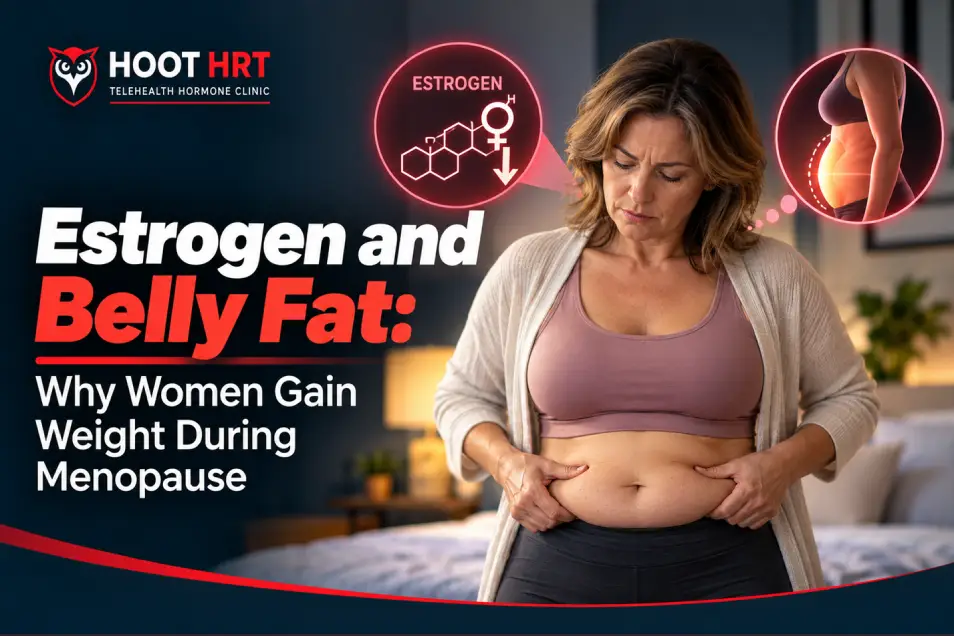
You haven’t changed what you’re eating. You’re not moving less. But something is different about your belly, and it didn’t start overnight. If you’re in your 40s or 50s and your midsection is changing while your habits haven’t, the connection between estrogen and belly fat is probably the explanation nobody has given you clearly.
This is not a willpower problem. It is a hormone-driven fat redistribution, and the biology behind it is well-documented.
Most women going through menopause expect to gain weight. What research actually shows is something more specific, and in some ways, more surprising.
A long-running study called the Study of Women’s Health Across the Nation, known as the SWAN study, tracked body composition in hundreds of midlife women across several years. Visceral fat, the fat stored around your internal organs, increased roughly 3.8 percent per year during the menopausal transition. Total body fat changed by only 0.02 percent per year. That difference matters enormously.
The scale may not move much. The belly does. That’s redistribution, not gain.
Visceral fat and subcutaneous fat are not the same thing. Subcutaneous fat sits just under the skin. You can pinch it. It’s the fat that gave premenopausal women the classic hip and thigh silhouette. Visceral fat surrounds your internal organs, sits deep in the abdomen, and behaves like a different biological material entirely. It doesn’t respond to calorie cuts the same way. It doesn’t look the same. And it carries different health risks.
One number worth knowing: belly fat accounts for roughly 5 to 8 percent of total body weight in premenopausal women. After menopause, that figure rises to 15 to 20 percent. The number on the scale can hold steady while your body composition shifts dramatically underneath it.
The standard advice to eat less and move more misidentifies the problem. The mechanism is not caloric. It’s hormonal. If you’re wondering whether hormone replacement therapy might be part of the picture, understanding the receptor-level shift is why that question matters.
Before menopause, estrogen was quietly directing where your body stored fat. When estrogen levels drop, it stops directing traffic, and the default route leads straight to your abdomen.
Here’s how that works. Fat cells carry a receptor called estrogen receptor alpha, or ERα. When estrogen is present and binding to ERα, it signals fat to preferentially store in subcutaneous depots, particularly the hips, thighs, and buttocks. Estrogen also suppresses the activity of an enzyme called lipoprotein lipase, known as LPL, specifically in abdominal fat. LPL is the enzyme that pulls fatty acids from the bloodstream into fat cells. When estrogen keeps it quiet in the abdomen, fat has less reason to accumulate there.
When estrogen declines, both of those effects reverse.
ERα signaling in subcutaneous fat weakens. LPL activity in abdominal fat rises. The abdomen, which was being actively held back from accumulating fat, starts winning the fat-storage competition. Meanwhile, estrogen receptor beta, or ERβ, is more concentrated in visceral fat and becomes relatively more active in those depots as ERα signaling declines. The net result is fat accumulation shifting from the hips and thighs toward the abdomen.
One nuance most articles miss: before menopause, the ovaries produce estradiol, the most potent form of estrogen. After menopause, the body still makes estrone, a weaker estrogen, mostly by converting androgens in fat tissue. Estrone doesn’t bind ERα effectively. The fat-directing signal is functionally gone.
This isn’t a metabolic failure. It’s a receptor-level shift with a predictable biological outcome. The fat isn’t going to your belly because you’re doing something wrong. It’s going there because the hormonal signal that kept it elsewhere is no longer present.
Cutting calories doesn’t restore ERα signaling. It doesn’t suppress LPL activity in your abdomen. The mechanism points toward the kind of evaluation that addresses the actual cause. You can learn more about how Hoot HRT’s evaluation process works to understand what that looks like in practice.
Most women think of menopause as the moment belly fat problems begin. The biology suggests it starts much earlier.
Perimenopause, the transition phase leading up to the final menstrual period, can last anywhere from two to ten years. During this time, estrogen doesn’t decline in a straight line. It surges and drops unpredictably. Some cycles produce high estrogen; others, very low. The problem is that even the surges become shorter and less sustained over time, which means the ERα signaling that held visceral fat in check becomes increasingly inconsistent.
That inconsistency is enough to begin the redistribution process years before estrogen permanently declines.
Something else happens during the transition that most health articles skip. Sex hormone-binding globulin, or SHBG, falls as perimenopause progresses. SHBG is a protein that binds hormones and keeps them temporarily inactive in circulation. When SHBG drops, more testosterone becomes bioavailable. SWAN study data found that rising bioavailable testosterone during the menopausal transition was independently associated with visceral fat increases.
Belly fat during perimenopause has two hormonal drivers, not one. Estrogen decline removes the brake. Rising bioavailable testosterone may add momentum.
If you’re in your mid-40s noticing belly changes while your cycle is still irregular, you’re not imagining it. The redistribution is likely already underway. Waiting until post menopause to evaluate hormones means letting the pattern establish itself over years before anything is addressed.
Visceral fat carries different health risks than subcutaneous fat, and the reason comes down to anatomy.
Subcutaneous fat sits passively under the skin. Visceral fat is positioned to drain directly into the portal vein, which carries blood from the abdominal organs to the liver. Every time visceral fat cells release inflammatory compounds, those compounds reach the liver first.
Visceral fat actively secretes TNF-alpha and interleukin-6. These cytokines arrive at the liver through portal circulation and drive insulin resistance, elevated triglycerides, and increased cardiovascular risk. This is why visceral fat accumulation after menopause is associated with higher rates of cardiovascular disease, type 2 diabetes, and non-alcoholic fatty liver disease. The fat is not passive. It behaves more like an inflamed organ than a storage depot.
Estrogen loss also reduces adiponectin, an insulin-sensitizing hormone produced by fat cells. Adiponectin levels drop measurably after oophorectomy. Lower adiponectin means worse insulin sensitivity, which means more insulin in response to the same food, which drives more fat into storage.
This is a feedback loop. More visceral fat reduces adiponectin. Lower adiponectin worsens insulin resistance. Worse insulin resistance drives more fat into the visceral depot.
Belly fat after menopause is not a cosmetic issue that can wait. The metabolic consequences accumulate well before they appear on a blood panel.
Hormonal fat redistribution would be challenging enough on its own. Menopause also reduces how many calories your body burns at rest, through several overlapping mechanisms.
Before menopause, estrogen promotes the conversion of white fat cells into beige fat cells. Beige fat burns calories as heat. After menopause, this conversion slows, lowering your resting metabolic rate independent of aging.
Muscle mass also declines more sharply after menopause. Muscle burns more calories at rest than fat tissue. The same diet that maintained your weight at 40 can produce a surplus at 50 with no change in behavior.
Estrogen buffers the body’s stress response by modulating the HPA axis. Without that buffer, normal daily stressors produce stronger cortisol responses. Chronically elevated cortisol promotes visceral fat storage and breaks down muscle tissue.
Sleep disruption from night sweats adds another layer. Poor sleep raises cortisol, increases ghrelin (the hunger hormone), and reduces leptin (the satiety hormone). More appetite and less calorie burn at the same time.
One factor that deserves specific attention: Hashimoto’s thyroiditis, an autoimmune thyroid condition, peaks in frequency during perimenopause. Hypothyroidism slows metabolism independently and amplifies every mechanism described above. If you’re gaining weight in the midsection during the menopausal transition, a TSH test belongs in your workup. Treating thyroid dysfunction while leaving hormones unaddressed is an incomplete approach. Hoot HRT’s women’s weight management program includes a thorough hormonal and metabolic evaluation to avoid exactly that gap.
The clinical evidence says yes, with important nuances about timing and individual candidacy.
A 2022 review of estrogen and adipose tissue published in Frontiers in Endocrinology found that estrogen therapy is associated with reduced visceral fat accumulation, lower fasting glucose, and improved insulin sensitivity in postmenopausal women. These aren’t cosmetic outcomes. They represent a measurable reduction in cardiometabolic risk, which is clinically meaningful independent of what the scale shows.
The timing matters. Starting hormone therapy earlier in the menopausal transition appears to interrupt the redistribution process before the pattern becomes established. Starting a decade or more after menopause may provide symptom relief but is less likely to reverse visceral fat that has accumulated over years. Earlier evaluation gives you more options.
Hormone therapy is not a weight loss drug. Women who start it don’t typically drop pounds on the scale. What the research supports is better body composition: less visceral fat accumulation, better preservation of lean mass, and improved metabolic markers.
The delivery method also matters clinically. Transdermal estrogen, delivered through patches, gels, or creams, maintains more stable hormone levels and avoids first-pass liver metabolism that oral estrogen undergoes. For women with an intact uterus, progesterone is added to protect the uterine lining. Micronized progesterone has a more favorable metabolic profile than synthetic progestins. Some women also benefit from low-dose testosterone, which supports lean mass, energy, and metabolic function during and after the transition.
Many women arrive at a hormone consultation worried about risks based on the 2002 Women’s Health Initiative. That study used oral conjugated equine estrogen combined with synthetic progestin in women who were, on average, more than a decade past menopause. Its findings don’t translate directly to transdermal bioidentical hormones or to women who start earlier in the transition. Current evidence supports a more favorable risk-benefit profile for appropriately evaluated candidates.
There are contraindications that require honest evaluation. A personal history of hormone-sensitive cancers, certain clotting disorders, and specific cardiovascular conditions affect candidacy. A thorough evaluation, not a general article, determines whether hormone therapy is appropriate for any specific person. Hoot HRT conducts those evaluations via telehealth for women across Texas. If you’re ready to understand your options, booking a consultation is where that conversation starts.

Hormone therapy addresses the root mechanism. Lifestyle changes support it, and for women who aren’t candidates for HRT, they remain the primary tools.
Resistance and strength training is the most important exercise change you can make during the menopausal transition. It preserves lean muscle mass and protects your metabolic rate. Two to three sessions per week, with gradually increasing challenges, is enough to produce measurable results.
High-intensity interval training, or HIIT, has the strongest evidence for reducing visceral fat compared to steady-state cardio. Research published in Sports Medicine found HIIT produced significantly greater reductions in abdominal and visceral fat than moderate-intensity continuous exercise. Twenty to thirty minutes, two to three times per week, is sufficient.
Prioritize sleep. Poor sleep raises cortisol, increases the hunger hormone ghrelin, and reduces the satiety hormone leptin. Addressing night sweats is metabolic management, not just comfort. If vasomotor symptoms are fragmenting your sleep, that’s worth evaluating on its own.
On the nutrition side, three changes carry the most evidence. Reduce alcohol, because the liver prioritizes processing alcohol over other metabolic tasks, which shifts fat storage toward the abdomen. Reduce refined carbohydrates and added sugars, because they drive insulin spikes that push fat toward visceral depots. Increase dietary protein, aiming for roughly 0.7 to 1 gram per pound of body weight, because protein preserves lean mass during a period when muscle loss is already accelerating.
Track your waist circumference alongside your weight. A waist measurement above 35 inches in women is a clinical marker for elevated visceral fat and metabolic risk. The scale doesn’t tell you where the fat is. Waist circumference does.
If you’ve been consistent with these changes for three to six months without results, the hormonal mechanism is likely the rate-limiting factor. That’s the conversation worth having with a provider who evaluates hormone levels, not just lifestyle habits.
Knowing the mechanism is the starting point. Acting on it is what changes the outcome.
At Hoot HRT, we evaluate the full hormonal picture for women in San Antonio, Austin, and across Texas through telehealth. If belly fat and body composition changes are part of what you’re dealing with, we look at estrogen, progesterone, testosterone, thyroid, and metabolic markers together, not in isolation. That’s the kind of evaluation that tells you whether HRT is appropriate, and what a realistic plan actually looks like for your situation.
Book a hormone evaluation when you’re ready to get a real answer.
——————————————————
Medical Review: Medically reviewed by John M. Cash, MD, Co-Founder and Medical Director, Hoot HRT
This article is for general educational purposes only. It does not constitute medical advice and is not a substitute for an evaluation by a qualified healthcare provider. Individual hormone levels, health history, and clinical circumstances vary significantly. Do not start, stop, or change any medical treatment based on the information in this article. If you have questions about hormone therapy or menopausal symptoms, speak with a licensed provider who can evaluate your specific situation. Hoot HRT is Hormone Optimization of Texas, a telehealth clinic serving patients in Texas.
Most women notice some degree of abdominal fat redistribution during the menopausal transition, but the extent varies significantly based on genetics, activity level, timing of hormonal changes, and whether hormone therapy is used. Redistribution is not inevitable. Early hormonal evaluation gives you more options for interrupting the process before the pattern becomes established.
Because it is different. Menopausal belly fat is primarily visceral fat, which sits around your internal organs rather than just under the skin. Because it accumulates behind the abdominal wall rather than in the pinchable layer just beneath the surface, the belly may feel harder and fuller rather than soft. It also doesn’t respond to calorie restriction the same way subcutaneous fat does. It’s a receptor-driven hormonal shift, not a caloric surplus problem, which is why lifestyle changes alone often don’t move the needle.
Clinical evidence shows that estrogen therapy is associated with reduced visceral fat accumulation and improved metabolic markers in postmenopausal women, particularly when started early in the menopausal transition. It is not a weight loss drug; the benefit is better body composition and lower cardiometabolic risk rather than scale weight. Whether you’re a candidate requires an individual evaluation. Hoot HRT offers telehealth hormone evaluations for women in San Antonio, Austin, and across Texas.
High-intensity interval training (HIIT) and strength training have the strongest evidence for reducing visceral fat specifically during menopause. HIIT targets visceral fat more effectively than steady-state cardio. Strength training preserves the lean muscle mass that keeps your metabolic rate from declining. Combining both produces better results than either alone.
Alcohol, refined carbohydrates, and added sugars have the greatest documented impact on visceral fat accumulation during menopause. Alcohol converts to acetate, which the liver uses preferentially for fuel while storing dietary fat. Refined carbs and sugars drive insulin spikes that push fat toward visceral storage. Ultra-processed foods compound the problem by displacing protein and fiber, both of which support lean mass and metabolic rate.
Some stabilization occurs in the years following menopause as hormone levels plateau at a new baseline. But visceral fat accumulated during the transition doesn’t automatically reverse without intervention. Most women who don’t address the underlying hormonal and metabolic factors see the redistribution persist or progress. A hormone evaluation is worth having before assuming the pattern is permanent.