

Co-Founder, Hoot HRT
Yes, TRT affects sperm production in most men, and it starts within weeks of the first dose. Exogenous testosterone suppresses LH and FSH, the two hormones that drive spermatogenesis in the testes, by shutting down the body's natural hormonal signaling chain. The effect is well-documented and clinically significant. For most men it is reversible, but recovery takes longer than expected and is not guaranteed without planning. At Hoot HRT, a cash-pay telehealth hormone clinic in San Antonio, Texas, the fertility conversation happens before any prescription is written.
Yes, TRT suppresses sperm production in most men, and it starts within weeks of the first dose. This is one of the most clinically significant side effects of testosterone therapy, and it is one of the most commonly skipped conversations before a man starts treatment.
The good news is that for most men the effect is reversible. The challenge is that recovery takes longer than almost anyone tells you upfront, it is not guaranteed without the right plan, and the window to act is before you start, not after a problem shows up.
This article covers exactly what happens to your sperm count on TRT, how fast it happens, whether fertility comes back, and the two clinical options every man should know about before his first prescription is written.
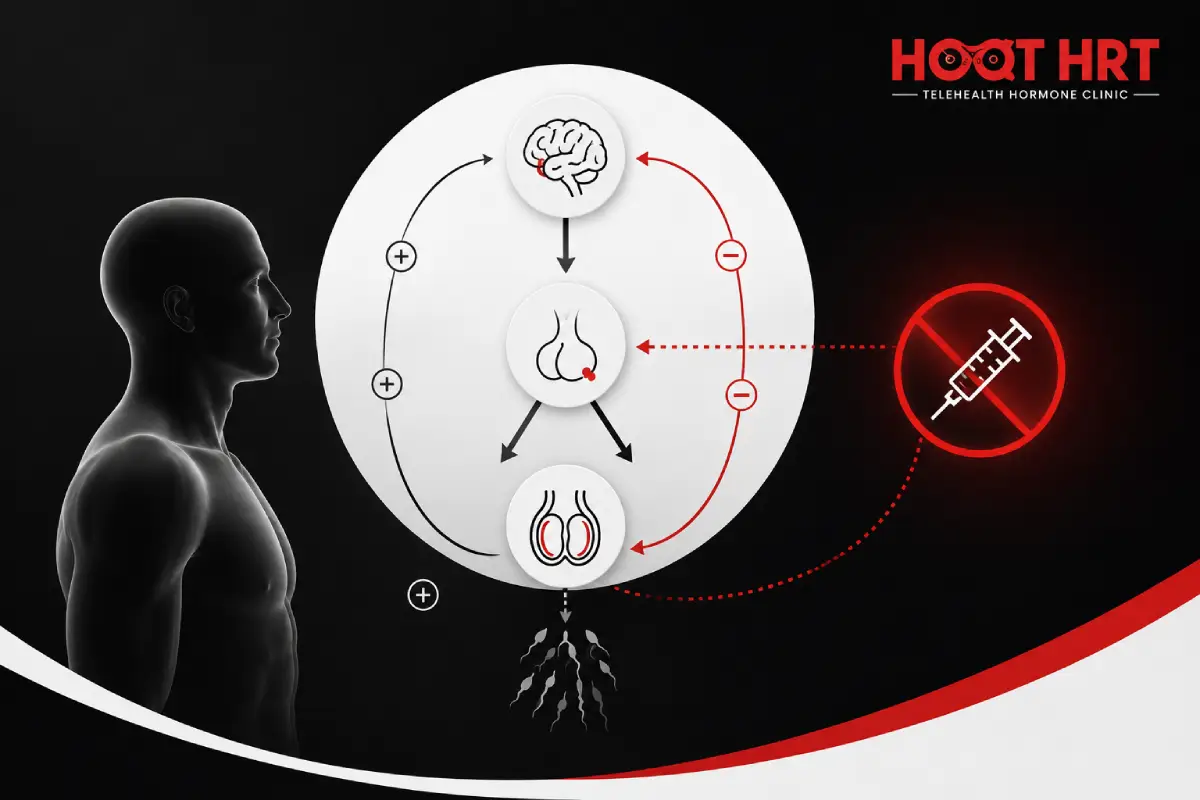
The body controls both testosterone and sperm production through a three-step hormonal chain called the HPG axis (hypothalamic-pituitary-gonadal axis). Here is how it works in plain terms.
The hypothalamus releases GnRH (gonadotropin-releasing hormone). The pituitary gland responds by releasing two hormones: LH (luteinizing hormone) and FSH (follicle-stimulating hormone). LH tells the testes to produce testosterone. FSH is what actually drives spermatogenesis, the biological process by which sperm cells are developed inside the testes.
When you introduce exogenous testosterone through TRT, your brain detects high circulating testosterone levels and responds by reducing GnRH output. LH and FSH both drop, often to near-zero. Natural testosterone production in the testes stops. And critically, FSH-driven spermatogenesis stops with it.
The same LH suppression that reduces sperm production also reduces testicular volume. Testicular shrinkage on TRT is caused by the same mechanism, because the testes are no longer receiving the LH signal that keeps them active. This is typically partial and reversible after stopping therapy, and gonadorelin co-therapy (covered below) addresses both issues simultaneously by maintaining the full LH and FSH signal.
The core point to understand: the problem is not that testosterone is harmful to sperm. The problem is that external testosterone removes the signal the body depends on to make sperm in the first place.
Understanding how testosterone replacement therapy interacts with the HPG axis is exactly why the fertility conversation belongs before treatment begins, not after.
Suppression begins within weeks of starting TRT, not months. A male contraceptive trial conducted by the World Health Organization, published in the Lancet, found that testosterone injections suppressed sperm counts to near-zero in approximately 65% of men by the fourth month of treatment. The mean time to azoospermia (complete absence of measurable sperm) was around 120 days. By six months, near-complete suppression was present in approximately 98% of participants.
Oligospermia (significantly reduced but detectable sperm) can appear within the first four to six weeks for some men. The timeline varies, but the direction does not.
One point that deserves direct language: TRT is not a reliable form of birth control. Sperm suppression is substantial in most men, but it is not universal, and breakthrough pregnancies do occur. If avoiding pregnancy is the goal, standard contraception should be used regardless of where your sperm count sits on TRT.
The month-by-month TRT results timeline explains how different systems respond at different stages of treatment. The reproductive system tends to respond earlier than most men are told.
For most men, yes. But the recovery timeline is longer and less predictable than most men expect, and it is not guaranteed for everyone.
Research published by Crosnoe et al. in Translational Andrology and Urology (2013) identified exogenous testosterone as one of the most common and preventable causes of male infertility. Recovery data consistently shows approximately 67% of men return to baseline sperm count within six months of stopping TRT, with that figure reaching around 90% at the twelve-month mark.
Here is the practical translation most articles leave out: if your partner wants to try to conceive in eight months, stopping TRT today does not guarantee you will be there by then. Many men will recover within that window. Some will not. The factors that affect recovery speed are how long you were on TRT, your age, and your baseline sperm parameters before you started.
What recovery actually feels like is also worth knowing. When you stop TRT, testosterone drops to hypogonadal levels before your natural production restarts. Most men feel significant fatigue, low mood, and reduced libido during this window. It is uncomfortable, and it can last weeks to months. This is not a reason to avoid stopping if fertility is the goal. It is information that makes the experience less surprising when it happens.
A very small proportion of men, estimated at less than one percent in prospective studies and typically those who were already subfertile before starting, do not fully recover without medical support. This is the exception, not the rule, but it underlines why a baseline semen analysis before starting TRT is not a minor detail.
Most content on TRT and fertility explains what the problem is. Very little explains what to do about it before it becomes one. These are the two options Hoot HRT discusses with every patient who raises fertility before a protocol is built. Which one makes sense depends on your goals, your timeline, and your individual evaluation.
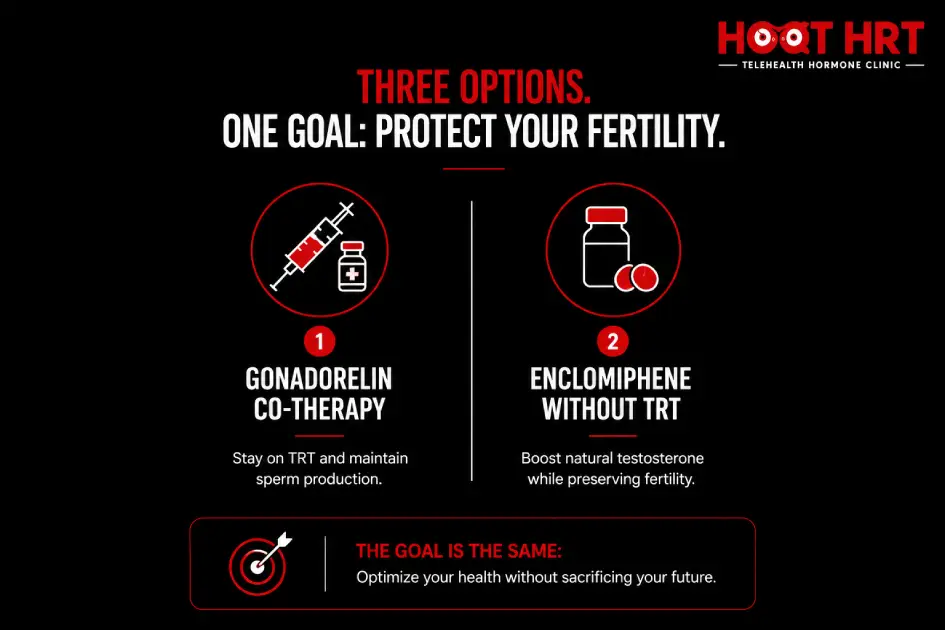
Gonadorelin is a synthetic form of GnRH that can be administered alongside testosterone therapy. By continuing to stimulate the pituitary gland to release both LH and FSH, gonadorelin maintains testicular function and sperm production even while exogenous testosterone is present in the system.
This is the key clinical difference between gonadorelin and HCG (human chorionic gonadotropin). HCG mimics LH only. Gonadorelin stimulates the full pituitary response, preserving both LH and FSH signaling simultaneously. Since FSH is what directly drives spermatogenesis, maintaining FSH is what makes gonadorelin more comprehensive for fertility preservation than HCG alone.
It is also worth knowing that HCG has faced compounding and availability challenges in recent years. Gonadorelin has become the more reliably available option for men who want fertility support built into their protocol from day one.
On the practical question of how well it works: available evidence suggests gonadorelin co-therapy substantially reduces the degree of spermatogenesis suppression in most men on TRT, though response is not uniform and some men will see more suppression than others depending on pre-existing testicular function. It is not a guarantee of full fertility preservation. It is the best currently available clinical tool for men who want to stay on TRT and reduce fertility risk simultaneously.
At Hoot HRT, gonadorelin is included in every patient’s protocol from day one, not reserved only for men with active fertility goals. The clinical reasoning is simple: preserving the HPG axis signal during TRT supports testicular function, reduces suppression, and makes recovery more predictable if a patient ever wants to stop therapy. For men in their early thirties where fertility is an active concern, this becomes a more detailed part of the conversation. For men in their forties, fifties, and sixties, the protocol is the same, but family planning is not typically a central topic unless the patient raises it.
For men who want to optimize testosterone but cannot accept any fertility risk at all, enclomiphene offers a fundamentally different approach. Enclomiphene is a selective estrogen receptor modulator (SERM) that blocks estrogen feedback at the pituitary gland. This causes the brain to read low estrogen signaling and respond by releasing more LH and FSH, which in turn stimulates natural testosterone production in the testes.
The critical difference from TRT: enclomiphene works with the HPG axis rather than bypassing it. Natural testosterone production continues. Spermatogenesis continues. There is no TRT contraceptive effect because no exogenous testosterone enters the system.
The ceiling this involves is real and worth explaining concretely. Enclomiphene can raise total testosterone, but it cannot push levels as high as direct testosterone injections can. For men with severely low testosterone (typically below 200 ng/dL with significant symptoms), enclomiphene may not produce enough improvement to resolve symptoms fully. For men with mildly to moderately low testosterone who have active fertility goals, it can be an effective middle path that improves how they feel without compromising sperm production. Whether your specific situation makes you a candidate requires an individual evaluation, because the answer depends heavily on your labs, your symptoms, and your timeline.
Understanding how Hoot HRT evaluates patients and builds a protocol before anything is prescribed gives useful context for how these options get incorporated into a real clinical plan.
The Endocrine Society’s 2018 clinical practice guideline for testosterone therapy in men with hypogonadism, authored by Bhasin et al. and published in the Journal of Clinical Endocrinology and Metabolism, specifically recommends fertility counseling for all men before initiating TRT. In most clinical settings, this recommendation is not followed.
How detailed this conversation gets at Hoot HRT depends on where a patient is in life. For a man in his early thirties, it is a full discussion. For a man in his forties, fifties, or sixties, family planning is not typically on the table, and the conversation reflects that. Gonadorelin is already built into every protocol regardless.
For patients where fertility is a genuine near-term concern, two questions shape the clinical plan.
Do you want children now, or within the next one to three years? If the answer is yes, the protocol monitoring shifts and enclomiphene as a full alternative gets a closer look depending on the severity of the deficiency.
Have you had a semen analysis? Do you know your baseline sperm count and motility? At Hoot HRT, a semen analysis can be discussed and ordered as part of the pre-treatment evaluation for patients where this matters. Without a baseline, there is no reference point if questions come up after six months of therapy.
These questions take a few minutes to work through. For the right patient at the right stage of life, the answers change the clinical plan entirely.
If you are currently on TRT and this is the first time you are thinking seriously about fertility, the right first step is a semen analysis, not stopping treatment cold.
Stopping TRT abruptly drops testosterone to hypogonadal levels before natural production restarts. As described above, most men feel significant symptoms during that window. That transition needs to be managed, not rushed, and should be done with provider support rather than on your own.
A semen analysis tells you where you actually stand right now. Sperm count suppression on TRT is not identical across all men. Some maintain more than expected. Knowing your current status is necessary before making any decision about changing your protocol.
From there, your provider can discuss whether adding gonadorelin, transitioning to enclomiphene, or working through a managed recovery protocol makes the most sense based on your labs and your timeline. This is a clinically manageable situation. It just needs a plan behind it.
If you are considering TRT and want the fertility conversation to be part of your evaluation before anything is prescribed, Hoot HRT provides individualized hormone assessments for men across Texas, including San Antonio, Austin, Houston, and Dallas, through telehealth.
Book a free initial consultation with Joe Hamm, PA-C. Fertility goals, lab baselines, and protocol options are part of every first conversation.
Written and Medically Reviewed by: Joe Hamm, PA-C, Co-Founder, Hoot HRT
Published by: Hoot HRT
Last Updated: August 2026
It is possible but significantly less likely. Research shows approximately 65% of men reach near-zero sperm count by month four on TRT, and around 10 to 15% of men maintain enough sperm production to conceive naturally while on therapy. At Hoot HRT in San Antonio, we discuss this before starting any patient in Texas on testosterone, because the answer affects what protocol makes sense.
Gonadorelin is a synthetic form of GnRH that maintains both LH and FSH signaling from the pituitary even while exogenous testosterone is present, which reduces the degree of spermatogenesis suppression compared to TRT alone. At Hoot HRT in Texas, gonadorelin is included in every patient’s protocol from day one, not only for men with active fertility goals. Available clinical evidence suggests it substantially reduces suppression in most men, though response is not uniform and full preservation is not guaranteed.
Recovery data shows approximately 67% of men return to baseline sperm count within six months of stopping TRT, and around 90% recover within twelve months. Individual recovery depends on age, duration of TRT use, and baseline fertility before starting. At Hoot HRT, we factor this timeline into the discussion before any patient in Texas starts treatment, particularly for men with active family planning goals.
No. While TRT suppresses sperm production substantially in most men, it is not universal and breakthrough pregnancies do occur. It should never be used as a contraceptive method. If avoiding pregnancy is the goal, standard contraception should be used alongside TRT regardless of sperm count status.
Enclomiphene stimulates natural testosterone production by blocking estrogen feedback at the pituitary, preserving the HPG axis and spermatogenesis entirely. TRT introduces exogenous testosterone that bypasses that axis and suppresses it. Enclomiphene has a ceiling on the testosterone levels it can achieve, making it most appropriate for men with mild to moderate deficiency and active fertility goals rather than men with severely low levels.
Yes. Gonadorelin is included in every patient’s protocol at Hoot HRT from day one, regardless of age or family planning status. For men in Texas in their early thirties where fertility is an active concern, enclomiphene as a full alternative also gets a closer look
In prospective studies, near-universal recovery of spermatogenesis is seen given enough time after stopping TRT. A very small proportion of men, estimated at less than one percent, and typically those who were already subfertile before starting, may require additional medical support to restore fertility. Earlier intervention, a documented baseline before starting, and regular monitoring during treatment all improve outcomes.