

Co-Founder, Hoot HRT
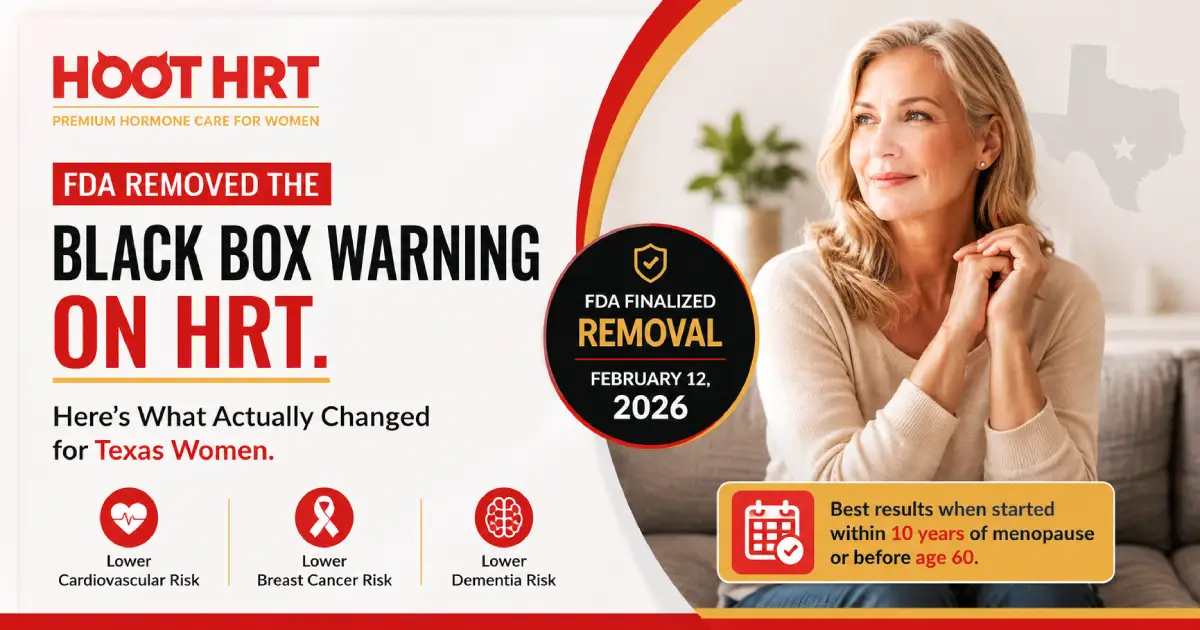
Short answer: In February 2026, the FDA finalized the removal of the black box warning from six categories of menopausal hormone therapy products, after first announcing the change in November 2025. For most women who start HRT before age 60 or within 10 years of menopause, the FDA now says the benefits outweigh the risks. One warning still stands: the endometrial cancer risk for estrogen-only therapy in women with a uterus.
If you’re a woman in your 40s or 50s who was told hormones were too dangerous to consider, or whose doctor waved you off without much explanation, this is worth ten minutes of your time. The label that shaped that conversation for twenty years just got rewritten.
Here’s where a lot of the coverage online gets sloppy, so let’s be precise about the timeline.
On November 10, 2025, HHS Secretary Robert F. Kennedy Jr. and FDA Commissioner Marty Makary announced that the agency would begin the process of removing broad black box warnings from menopausal hormone therapy. That was the announcement. The actual labeling change went through review, and the FDA approved it on February 12, 2026, for six categories of HRT products: estrogen and progesterone combinations, systemic estrogen-alone therapy, systemic progestogen-alone therapy, and topical vaginal estrogen.
Commissioner Makary put it bluntly at the press conference: the agency was correcting course “wherever the evidence demands it.” The warnings being removed covered cardiovascular disease, breast cancer, and dementia risk, the same three risks that scared an entire generation of women and their doctors away from treatment.
One warning didn’t move. The FDA kept the endometrial cancer caution on estrogen-only products for women who still have a uterus, because unopposed estrogen genuinely does raise that risk. That’s not the agency softening its stance across the board. It’s the agency being specific about where the real risk lives.
The 2003 black box came out of the Women’s Health Initiative, a large federal study that spooked doctors and patients alike when its early results hit the news. The study itself wasn’t flawed. The problem was how it got applied.
Most of the women in that study were in their 60s and 70s, a decade or more past menopause. The FDA then applied those findings to every woman on hormone therapy, including women in their 40s just starting to deal with hot flashes and sleep loss. Even the original breast cancer signal that drove so much fear didn’t reach statistical significance in the initial data.
The fallout was real. HRT prescriptions collapsed in the early 2000s, and a whole generation of clinicians trained during that window learned one lesson: hormones are risky, avoid them. If your own doctor still hesitates on this topic, that’s usually where it’s coming from. It’s not indifference. It’s twenty-year-old training that the evidence has now outgrown.
The core of the FDA’s updated position is what researchers call the timing hypothesis: start hormone therapy within about 10 years of your last period, generally before age 60, and the risk-benefit picture looks completely different from it did for women decades past menopause.
Randomized trial data in that early window point to lower all-cause mortality, fewer fractures, and a meaningful reduction in cardiovascular risk. That’s a strong evidence base, not a marketing claim. Some of the bigger numbers you’ll see in headlines about Alzheimer’s risk reduction come from observational studies, which are promising but not yet as solid as the cardiovascular data. We’d rather tell you that plainly than let you assume every number in a headline carries equal weight.
No, and this is where a lot of coverage of the FDA news gets it wrong. The black box removal is specific to estrogen and progesterone-based menopausal hormone therapy. It doesn’t touch testosterone.
That doesn’t mean testosterone for women lacks evidence. A 2019 systematic review and meta-analysis covering 36 randomized trials and more than 8,000 women found that testosterone meaningfully improved sexual desire, arousal, and satisfaction, with transdermal delivery preferred to avoid affecting cholesterol. A global consensus statement endorsed by ten medical societies reached the same conclusion for postmenopausal women with low sexual desire.
On brain fog specifically, we won’t oversell it. That same consensus statement found the evidence isn’t there yet to say testosterone sharpens thinking or slows cognitive decline. A lot of women feel clearer once their sleep, energy, and overall hormone picture improve, but that’s different from a proven cognitive benefit, and we’re not going to blur that line for you.
Perimenopause takes real time to evaluate properly: a full history, repeat labs, and ongoing adjustment. Most healthcare visits aren’t built for that.
OB/GYNs are often running deliveries and surgeries, and don’t have room in the schedule for hormone optimization. Primary care doctors frequently avoid starting HRT because of the testing burden and because insurance often won’t cover it well. So the patient lands in the middle: symptomatic, dismissed, and told to wait until things get bad enough to count.
That’s backwards. Research consistently shows that patients who take an active role in managing their own health tend to do better and spend less over time than patients who wait for the system to catch up (Hibbard & Greene, Health Affairs, 2013). You don’t need permission to stop waiting.

We built Hoot HRT’s women’s hormone program around the FDA’s own guidance: full labs, an individualized plan, and honest conversations about what’s proven versus what’s still emerging. We’re not chasing a number on a lab report. We spend 30 to 45 minutes on your first visit understanding your actual life, sleep, stress, and symptoms before recommending anything.
We serve women across Texas by telehealth, from San Antonio to Austin, Dallas, Houston, and Waco. Every plan includes ongoing lab monitoring, not a one-time prescription. You can see how the process works, check current pricing, or book a free consultation to talk through your symptoms with a provider directly. If low libido or sexual health is the main concern, our sexual health program covers that specifically. There’s no long-term contract, and you can stop at any time.
Twenty years of caution built around one misapplied study kept a lot of women from getting help they needed. That’s changing, but the FDA’s decision is a correction, not a green light to skip evaluation. The endometrial cancer warning is still there for a reason, and any decision about starting HRT belongs between you and a clinician who’s actually looking at your labs.
Written and Medically Reviewed by: Joe Hamm, PA-C, Co-Founder, Hoot HRT
Published by: Hoot HRT
For most women under 60 who start within 10 years of menopause, the FDA now considers HRT safe and beneficial based on its February 2026 labeling decision. At Hoot HRT, we still run full labs and monitor every patient in Texas closely, because “safe for most women” isn’t the same as “safe for every woman.”
In February 2026, the FDA approved removing the cardiovascular disease, breast cancer, and dementia warnings from six categories of menopausal hormone therapy products. The endometrial cancer warning stays on estrogen-only products for women who still have a uterus.
No. The FDA’s black box removal covers estrogen and progesterone-based menopausal hormone therapy, not testosterone. Hoot HRT prescribes testosterone for women with low libido based on separate clinical trial evidence, using the same lab-guided, monitored approach we use statewide across Texas.
Hoot HRT is a cash-pay telehealth clinic, so we don’t bill insurance directly, but we provide superbills you can submit to your insurer for possible out-of-network reimbursement. Whether you get reimbursed depends entirely on your specific plan.
You can book a free telehealth consultation with Hoot HRT from anywhere in Texas, including San Antonio, Austin, Dallas, and Houston. A provider reviews your labs and symptoms before recommending a treatment plan, with no long-term contract required.
This article is for educational purposes and isn’t individual medical advice. Hormone therapy carries real risks and benefits that depend on your personal health history. Any decision to start, change, or stop HRT should be made with a qualified clinician who can evaluate and monitor you directly.