

Co-Founder, Hoot HRT
No. Clinical evidence does not support the idea that HRT causes fat gain. A Cochrane review of 28 RCTs involving 28,559 women found no significant difference in weight gain between HRT and placebo. What many women experience during the first few weeks is temporary fluid retention, rather than fat gain. This may resolve within four to eight weeks. Body composition research also suggests HRT may help limit visceral fat accumulation.
Hoot HRT evaluates hormones for women across San Antonio, Austin, and Texas through telehealth.
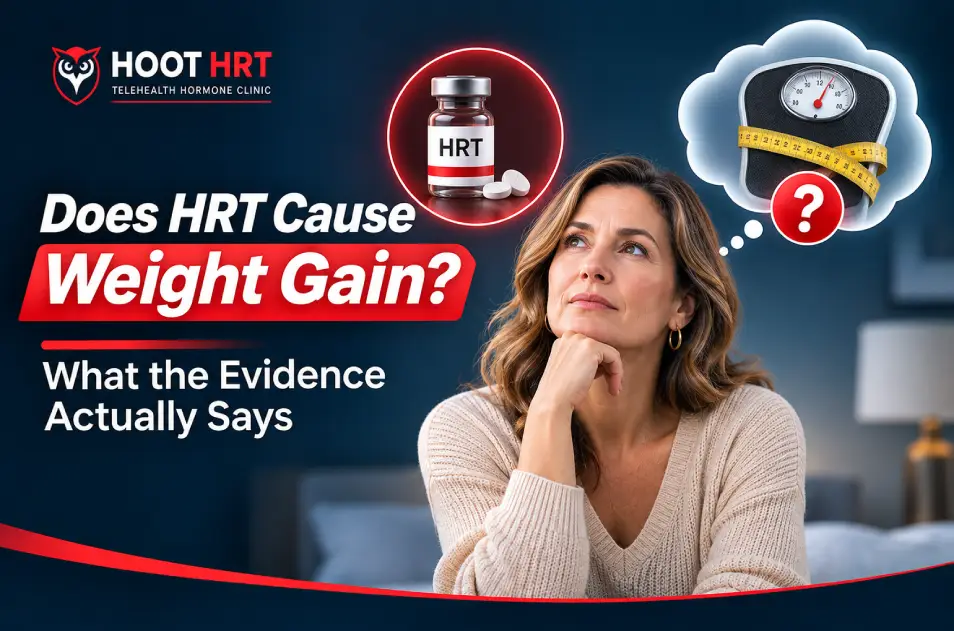
You’ve probably heard it from a friend, read it in a forum, or maybe even been told by a provider: “HRT will make you gain weight.” It’s one of the most common reasons women hold off on hormone therapy, or stop it too soon after starting. The concern is real. The fear behind it is understandable.
But does HRT actually cause weight gain? The clinical evidence says no. And once you understand what the research actually shows, and why so many women have the experience of the scale moving early on, the whole picture looks very different.
Let’s start with the strongest data, because it’s more reassuring than most women expect.
A Cochrane systematic review analyzed 28 randomized controlled trials involving 28,559 women. The finding: no significant weight gain from HRT versus placebo. Women on estrogen alone gained an average of 0.03 kg more than controls. Women on combined estrogen-plus-progestogen gained 0.04 kg more. That’s not a rounding error on the scale. That’s essentially nothing. The 2022 North American Menopause Society Hormone Therapy Position Statement reached the same conclusion, as did more recent trial data.
The REPLENISH trial is the one most people haven’t heard about, and it’s the most compelling. It was a randomized controlled trial of 1,835 women over 12 months, testing oral bioidentical estradiol combined with micronized progesterone, the same type of bioidentical HRT that Hoot HRT uses. Researchers tracked clinically meaningful weight change, defined as gaining at least 11.3 kg with a greater than 15% increase from baseline. Here’s the result: 1.1 to 2.6 percent of women in the HRT group met that threshold, versus 2.2 percent in the placebo group. More women on placebo had significant weight gain than women on HRT.
Read that again. More weight gain in the group that was NOT on HRT.
There is also a timing problem that gets overlooked constantly. Most women start HRT in their late 40s or early 50s, which is exactly when midlife weight gain tends to accelerate anyway. If you start HRT and gain weight over the next year, it feels like HRT caused it. But the menopausal transition drives fat redistribution on its own, whether you’re on hormones or not. Untangling those two things is what the research is actually designed to do. When researchers do it correctly, HRT doesn’t cause weight gain.
Learn more about Hoot HRT’s women’s hormone therapy service and how candidacy is evaluated.
Here’s the part that explains why so many women are convinced HRT caused them to gain weight, and why they’re not entirely wrong about what they experienced, just wrong about what it was.
Estrogen has a mild effect on fluid balance. It promotes sodium and water retention, particularly at higher doses or when taken orally. In the first two to four weeks on HRT, this can add two to four pounds. The scale goes up. Clothes feel a little tighter. It happens fast. Sometimes within days.
That is fluid. Not fat.
Fat doesn’t accumulate in days or weeks. It builds gradually over months, through sustained caloric surplus and metabolic change. Fluids can shift in 48 hours. The physical signs are also different: fluid retention tends to show up as puffiness in the face, hands, ankles, or abdomen. It feels different than the gradual softening of fat gain. Once you know what to look for, the two are distinguishable.
The timeline matters here. Estrogen-related fluid retention typically peaks in weeks one through four and resolves by weeks four to eight as your body adjusts to the new hormone level. If the puffiness and scale increase disappear in that window, that’s exactly what happened: fluid retention, resolved.
If it’s still there at eight weeks, that’s a signal about your formulation, not a verdict on HRT itself. A lower dose, switching from oral to transdermal delivery, or changing the type of progestin typically resolves it. This is a solvable problem. It doesn’t mean HRT isn’t right for you.
Find out more about how Hoot HRT evaluates and adjusts hormone regimens when early symptoms like this come up.
This is the part of the conversation that almost never happens, and it explains a lot of the confusion about HRT and weight.
Not all progestins are the same. Medroxyprogesterone acetate, known as MPA or Provera, was the progestin used in the Women’s Health Initiative, the 2002 study that scared a generation of women and providers away from HRT. MPA is a synthetic progestin that doesn’t just bind the progesterone receptor. It also binds the glucocorticoid receptor, which is the same receptor that cortisol binds. When you activate the glucocorticoid receptor, you get cortisol-like effects: sodium retention, increased appetite, and a tendency to store fat.
So yes, women on MPA-based HRT may have experienced real weight changes. The mechanism is there. But that mechanism is specific to MPA, not to hormone therapy as a category.
Micronized progesterone, the kind in Prometrium and Utrogestan, works completely differently. It binds selectively to the progesterone receptor, with no meaningful glucocorticoid or androgenic activity. It doesn’t produce the cortisol-like effects that MPA does. Clinical evidence supports a metabolically neutral profile, meaning it doesn’t drive the fluid retention and fat storage that MPA can cause.
There’s also a sleep angle that doesn’t get discussed enough. When your body processes progesterone, it converts some of it to a compound called allopregnanolone. Allopregnanolone acts on GABA receptors in the brain, the same receptors involved in promoting deep, restorative sleep. Better sleep means lower cortisol. Lower cortisol means less visceral fat storage. Micronized progesterone, through this pathway, may actually work in your favor on body composition, which is the opposite of what MPA can do.
When someone says “HRT caused weight gain,” they are usually talking about outcomes from older, synthetic progestin-based regimens. Those outcomes don’t apply to bioidentical micronized progesterone, which is the current standard for women with a uterus who need progestogen coverage.
Here’s where the research gets most interesting, and where the standard HRT conversation is missing something important.
Most people ask: “Does HRT cause weight gain?” A more useful question is: “What does HRT actually do to body composition?” Those are different questions, and they have different answers.
The OsteoLaus cohort study followed 1,053 postmenopausal women and measured their body composition directly. Current HRT users had significantly lower visceral fat than women who had never used HRT. They also had a lower age-adjusted body mass index, roughly 0.9 kg per square meter lower on average. The most striking finding: the 10-year increase in visceral fat that occurred naturally in non-users was essentially absent in current HRT users.
To be clear, OsteoLaus is a cohort study, not a randomized trial. Women who chose to stay on HRT for years may differ from non-users in other ways that influence the result. But the direction of effect (less visceral fat in HRT users) is consistent with the randomized trial data showing no fat gain, and with the known mechanisms of estrogen on fat distribution.
A small pilot study by Costa et al. in 2020 followed 32 women over six months and found that the HRT group maintained flat trunk fat while the control group gained trunk fat significantly (p=0.04). Body fat percentage rose in the control group but not in the HRT group. Small sample, but the same pattern.
This is why the scale is the wrong tool. If HRT is preserving muscle mass (which it may do by slowing the sarcopenia that accelerates at menopause), you could be gaining a small amount of lean mass while losing fat. The scale ticks up slightly. Body composition is actually improving. A woman who weighs herself every morning and concludes HRT isn’t working may be looking at the wrong number entirely. Waist circumference is a better measurement. So is how your clothes fit.
For women whose evaluation includes testosterone, there’s an additional layer worth knowing. Low testosterone in women is associated with reduced lean mass and increased fat mass, independent of estrogen. Restoring testosterone to a healthy physiologic range, where clinically indicated, may support lean mass preservation on top of what estrogen provides. A full hormone panel looks at the complete picture.
This context matters because it changes what you can reasonably expect from hormone therapy.
Menopause itself sets off a chain of events that promote weight gain, and most of them have nothing to do with whether you’re on HRT. Estrogen decline accelerates sarcopenia, the age-related loss of muscle tissue. Less muscle means a slower resting metabolism. Fewer calories burned at rest means more stored as fat, even if nothing changes in your diet.
Estrogen also plays a role in activating thermogenic fat cells, the kind that burn calories to generate heat. As estrogen declines, that calorie-burning process slows. This contributes to weight gain in ways that are completely independent of what you eat or how much you exercise.
On top of that, the stress response becomes harder to buffer. Estrogen helps regulate the hypothalamic-pituitary-adrenal axis, which governs cortisol output. Without it, cortisol responses to ordinary stress can run higher, and chronically elevated cortisol is directly associated with visceral fat storage. Add night sweats and disrupted sleep into the mix, which increases the hunger hormone ghrelin, suppresses the satiety hormone leptin, and raises cortisol further. You have a biological environment that actively promotes weight gain regardless of hormones.
HRT may interrupt some of these mechanisms, particularly the visceral fat redistribution. But it doesn’t undo everything. Strength training matters. Protein intake matters. Sleep quality matters. No hormone regimen makes lifestyle irrelevant.
One more thing worth checking: Hashimoto’s thyroiditis, an autoimmune thyroid condition, peaks in perimenopause. Its symptoms, fatigue, weight gain, cold sensitivity, slow metabolism, overlap almost completely with menopause symptoms. Undiagnosed or undertreated hypothyroidism can drive weight gain that has nothing to do with hormones. A TSH check belongs in any menopausal weight workup.
If you’re managing weight during the menopausal transition, explore Hoot HRT’s women’s weight management program, which addresses both the hormonal and metabolic sides of the picture.
Most women don’t think about this side of the equation, but the evidence is worth knowing before you make a decision.
The OsteoLaus cohort found that women who had stopped HRT had no residual visceral fat benefit compared to women who had never used it at all. Past users looked the same as never-users when it came to visceral fat. The protection was gone.
What this suggests is that the body composition benefit of HRT is active and ongoing. It’s not something that accumulates and then stays with you. It’s there while you’re on therapy, and it stops when you stop.
So if you’re thinking about stopping HRT because you’ve been gaining weight, consider what the evidence actually says will happen. The visceral fat redistribution that HRT was interrupting will likely resume. Body composition may worsen. If weight is accumulating on HRT, the right question is whether the formulation needs adjusting (the dose, the delivery route, the progestin type), not whether to stop. Those are different problems with different solutions.
Book a hormone evaluation with Hoot HRT if you’re trying to figure out whether a formulation change makes sense for you.
If you’re on HRT and the number has moved, here’s how to think about what you’re seeing.
If the weight appeared fast, within days to two weeks, and you’re noticing puffiness in your face, hands, or ankles, that’s almost certainly fluid retention. The right move is to give it four to eight weeks and recheck. If it resolves on its own, you don’t need to do anything. If it’s still there at eight weeks, a formulation adjustment usually fixes it.
If the weight is creeping up slowly over months and your waist circumference is increasing, that’s a different signal. That pattern warrants a full metabolic workup: thyroid function (TSH), fasting glucose, and HOMA-IR to check for insulin resistance. These conditions frequently compound at perimenopause and are often mistaken for hormone-related changes.
If the scale has gone up slightly but your waist is flat or smaller and your clothes fit better than before, that’s lean mass. That’s a good outcome the scale is misrepresenting. Don’t stop HRT because of it.
Practical tools worth using: waist circumference measured monthly, clothing fit as a proxy, and daily scale weigh-ins kept to a minimum since scale weight fluctuates with fluid throughout the day and week. If you want a clear, accurate picture of what’s actually happening to your body composition, a DEXA scan is the gold standard. It separates fat mass, lean mass, and visceral fat precisely, which is far more informative than anything a bathroom scale can tell you.
If you’re in perimenopause or postmenopause and weight changes are part of what you’re dealing with, a proper hormone evaluation can help separate what’s hormonal from what’s metabolic from what’s within your direct control. The fear that keeps many women from HRT was built on older synthetic formulations, a decade-old study, and a bathroom scale that doesn’t tell the full story.
At Hoot HRT, we start with labs, not assumptions. We look at the full hormone picture (estrogen, progesterone, testosterone, and thyroid), so the plan we build is based on what’s actually happening in your body, not a guess. We serve women across San Antonio, Austin, and Texas via telehealth, and the first step is a conversation.
Clinical trial evidence consistently shows no meaningful fat gain from HRT compared to placebo. A Cochrane review of 28 randomized controlled trials and 28,559 women found a difference of only 0.03 to 0.04 kg between HRT and placebo groups. The REPLENISH trial found that more women on placebo had clinically significant weight gain than women on HRT. Hoot HRT evaluates hormone therapy for women across Texas via telehealth.
Most early weight increases on HRT are fluid, not fat. Estrogen promotes mild sodium and water retention in the first weeks on therapy, which can add two to four pounds quickly. If the weight appeared within days and comes with puffiness in your face or ankles, that is the most likely explanation. Fluid retention from HRT typically resolves by weeks four to eight. If it persists longer, a formulation adjustment is usually the fix, not stopping therapy.
Transdermal estradiol paired with micronized progesterone has the most favorable metabolic profile. Transdermal delivery bypasses first-pass liver metabolism, avoiding the SHBG elevation that oral estrogen can cause. Micronized progesterone does not bind the glucocorticoid receptor the way medroxyprogesterone acetate does, so it avoids the cortisol-like fluid retention and fat storage effects tied to synthetic progestins like Provera.
Probably not, and body composition may actually worsen. The OsteoLaus cohort found that women who had stopped HRT had no residual visceral fat benefit compared to women who had never used it. The visceral fat redistribution that HRT was slowing likely resumes after stopping. If weight is accumulating on HRT, adjusting the formulation is the more evidence-supported path than discontinuing.
The OsteoLaus cohort found that current HRT users had significantly lower visceral fat, and that the 10-year age-related increase in visceral fat was absent in current users. HRT is not a weight loss drug, but the evidence suggests it may interrupt the visceral fat redistribution that accelerates after menopause. Hoot HRT evaluates whether hormone therapy is appropriate for women in San Antonio, Austin, and across Texas.
Early on, temporary fluid retention is the most common explanation. Later, if HRT is slowing sarcopenia while reducing fat, lean mass may increase slightly as fat decreases. The scale can stay flat or tick up modestly while body composition is actually improving. Waist circumference and clothing fit are more informative than daily scale weight when tracking hormonal changes.
In most cases, no. Early weight changes on HRT are almost always temporary fluid retention that resolves within four to eight weeks. If fluid retention persists past eight weeks, switching from oral to transdermal estradiol or changing the progestin type typically resolves it. Long-term fat accumulation is not a documented effect of HRT at the population level. If weight continues to climb after the adjustment period, a full metabolic workup (including thyroid and insulin resistance markers) is the right next step, not stopping HRT.
This article is for informational purposes only and does not constitute medical advice, diagnosis, or treatment. Individual responses to hormone therapy vary, and the information presented here reflects population-level clinical data and research findings. Hormone replacement therapy involves real risks and benefits that require individualized evaluation by a licensed provider. Not all women are candidates for HRT. Consult a qualified healthcare provider before starting, changing, or stopping any hormone therapy. Hoot HRT provides telehealth evaluations for residents of Texas only.
Kongnyuy EJ, et al. “Oestrogen and progestogen HRT for peri- and post-menopausal women: weight and body fat distribution.” Cochrane Database of Systematic Reviews. 2000. CD001018.
Black DR, et al. “Effects of combined 17beta-estradiol and progesterone on weight and blood pressure in postmenopausal women of the REPLENISH trial.” Menopause. 2020; 28(1):32-39. PMC7769186.
Papadakis GE, et al. “Menopausal Hormone Therapy Is Associated With Reduced Total and Visceral Adiposity: The OsteoLaus Cohort.” Journal of Clinical Endocrinology and Metabolism. 2018; 103(5):1948-1957. PMID: 29596606.
Costa GBC, et al. “Influence of Menopausal Hormone Therapy on Body Composition and Metabolic Parameters.” BioResearch Open Access. 2020; 9(1):80-85. PMC7097676.
Women’s Health Concern. “Weight Gain and Menopause.” Factsheet. September 2026.
Lizcano F, Guzmán G. “Estrogen Deficiency and the Origin of Obesity during Menopause.” Biomed Res Int. 2014; 2014:757461. PMC4137509.
The Menopause Society. “2022 Hormone Therapy Position Statement.” Menopause. 2022; 29(7):767-794.