

Co-Founder, Hoot HRT
Most men don’t come to us talking about a number. They come in describing a slow fade. The drive that used to get them out of bed before the alarm is gone. The edge they brought to their work has dulled. The body that used to respond to the gym now ignores it. Their wife or partner has noticed they’re flatter, quieter, less them. They’ve started to wonder if this is just what getting older feels like, if this diminished version is who they are now.
Here is the truth: for many of these men, that fade is not their character or their age. It is a hormone. Clinically, low testosterone, called hypogonadism, is defined as total testosterone below 300 nanograms per deciliter (ng/dL) combined with symptoms. It affects roughly 39 percent of men over the age of 45, and most of them have no idea the number is the problem.
This article covers what low testosterone actually is, every symptom to watch for, what causes levels to drop, how it gets properly diagnosed, and the difference it makes when it is treated in the right patient, the right way.
Let me speak to the part most clinics skip. When testosterone is restored in a genuinely low man, the change is not just a lab value. It is an identity shift. Men describe walking back into a room the way they used to present, steady, sure of themselves. The drive returns: the ambition to build, to compete, to provide, to lead. The quiet confidence that makes a man magnetic to a partner comes back online. The discipline to train, eat well, and show up consistently gets easier because the biological engine underneath it is finally running.
I want to be honest with you, because honesty is what separates us from the mills: testosterone is not a shortcut to wealth, status, or a relationship. It will not hand you a life. What it can do, when you actually need it, is give you back the energy, focus, drive, and physical presence you need to go build that life yourself. It restores your capacity. What you do with it is the transformation.
Testosterone is the primary male sex hormone. It drives muscle growth, bone density, red blood cell production, sex drive, energy, and mood. Your hypothalamus signals your pituitary gland to release luteinizing hormone (LH), which tells your testicles to produce testosterone. When any part of that chain breaks down, levels fall.
Clinically, a total testosterone level below 300 ng/dL, confirmed on two separate morning blood draws, is considered low. Normal adult male levels generally range from 300 to 1,000 ng/dL. But the number alone does not tell the full story. Symptoms matter as much as the result on paper. A man at 295 ng/dL who feels and functions well is a different case from a man at 295 ng/dL who cannot get out of bed.
Testosterone declines naturally with age, roughly 1 to 2 percent per year beginning in the mid-to-late 30s. Not every man with declining levels will feel it. The men who come to us feel it.
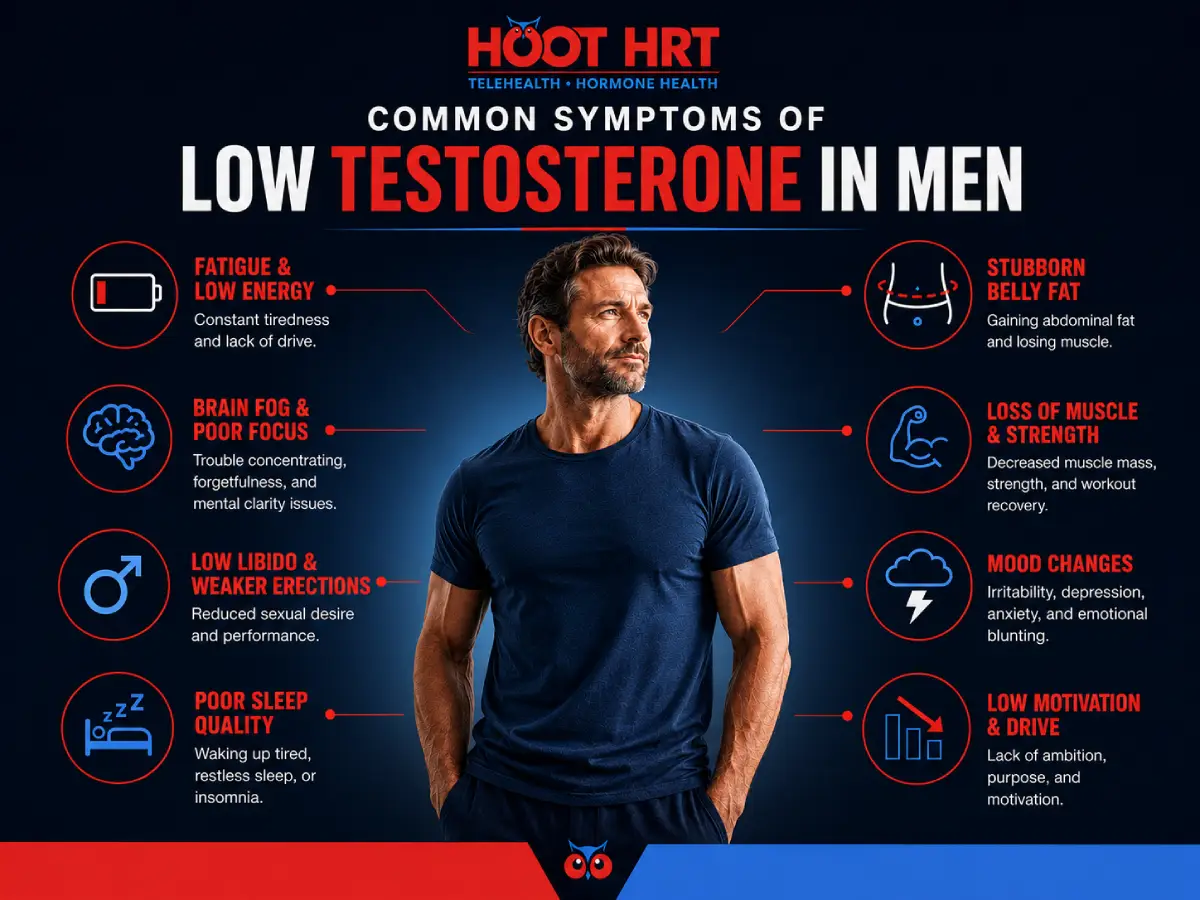
Low testosterone shows up across body and mind. No single symptom confirms it, and many of these overlap with thyroid disease, sleep apnea, chronic stress, and metabolic disease, which is precisely why the lab number is only the beginning of the story. Here is what to watch for. (StatPearls: Male Hypogonadism, https://www.ncbi.nlm.nih.gov/books/NBK532933/; Practical guide to male hypogonadism, https://www.ncbi.nlm.nih.gov/pmc/articles/PMC2948422/)
Not sleepy flat. A persistent lack of drive and vitality that a full night of sleep and three cups of coffee do not fix. Testosterone is closely tied to your metabolic rate and your sense of energy. As levels fall, lethargy and a general absence of motivation tend to follow. Men describe it as running on a battery that never fully charges.
Trouble focusing, losing words mid-sentence, slower recall, reduced mental clarity. Cognitive decline, particularly in verbal memory and visual-spatial processing, is a documented feature of testosterone deficiency. It is also one of the symptoms men find most disorienting because it affects professional performance and self-image in ways that are hard to explain to others.
Reduced sexual desire and fewer spontaneous erections, including morning erections, are among the most specific symptoms of low testosterone. Testosterone acts as a vasodilator and plays a direct role in arousal. When levels drop, interest fades, and erectile response weakens. This is not always about erectile dysfunction in the clinical sense; many men with low T simply notice the drive has gone quiet.
Gaining fat around the abdomen while losing lean muscle, and being unable to reverse it regardless of how consistently you train or how carefully you eat, is a classic metabolic signature of low testosterone. Testosterone is an anabolic hormone. Without enough of it, the body favors fat storage over muscle synthesis. The fat itself then worsens the problem: fat cells contain aromatase, an enzyme that converts testosterone to estrogen, driving levels lower still.
One of the most under-recognized and most damaging symptoms. Men with low testosterone are at significantly higher risk of depressive symptoms, irritability, and emotional blunting. Testosterone crosses into the brain, where it influences the production of feel-good neurotransmitters and helps regulate mood. Without adequate levels, many men become shorter-tempered, less resilient, and emotionally flatter than they used to be. This is one of the most damaging symptoms to relationships and careers, and the one men are least likely to connect to a hormone.
Testosterone and sleep are tightly linked. Levels peak during deep sleep, and disrupted sleep pulls them lower. Low testosterone raises cortisol, which promotes wakefulness and contributes to lighter, shorter sleep cycles. Many men with low T report waking repeatedly through the night or sleeping seven to eight hours and still feeling unrefreshed. Sleep apnea, one of the most common underlying causes of secondary low testosterone, makes this worse in both directions: apnea suppresses testosterone, and low testosterone impairs sleep quality.
Testosterone drives androgen-dependent hair growth in the chest, pubic region, armpits, and beard. Men with low T often notice thinning or loss of body and facial hair over time. Some men also experience hot flashes as testosterone drops and cortisol rises, a symptom that surprises most men because they associate it only with menopause. Over the longer term, untreated low testosterone contributes to bone density loss. Osteoporosis in men is underdiagnosed and often connected to years of unaddressed testosterone deficiency.
This one is harder to pin to a symptom on a checklist, but it is the one men most often describe when they walk through our door. The hunger to build, compete, and lead feels gone. Projects that used to excite them sit unfinished. They are not depressed in a clinical sense; they are simply not themselves. Testosterone is directly involved in dopaminergic pathways and reward-motivated behavior. When it is low, the drive to pursue and accomplish falls with it.
Several factors reduce testosterone production. Understanding the cause matters because treating the symptom without addressing the root leads to incomplete results.
Age is the most common factor. Natural decline begins around 35 to 40 and accelerates from there. It is not a disease; it is biology. But for many men, the pace of decline is steep enough to produce real symptoms.
Obesity directly suppresses testosterone. Fat cells produce aromatase, which converts testosterone to estrogen. Higher body fat means lower T and higher estrogen, which further disrupts the hypothalamic-pituitary-gonadal axis.
Sleep apnea is one of the most underappreciated causes. Fragmented, low-quality sleep suppresses the overnight testosterone surge that keeps levels adequate during the day. Treating sleep apnea alone can meaningfully raise testosterone in some men.
Chronic stress keeps cortisol elevated, which competes with testosterone at the receptor level and suppresses production at the hypothalamic level.
Other medical and pharmacological factors include pituitary gland disorders, type 2 diabetes, certain medications (particularly opioids, corticosteroids, and some antidepressants), alcohol overuse, and prior injury or surgery affecting the testicles or pituitary.
This is why a real evaluation includes far more than a testosterone number.

Diagnosis requires two things: symptoms and a confirmed lab value on two separate occasions.
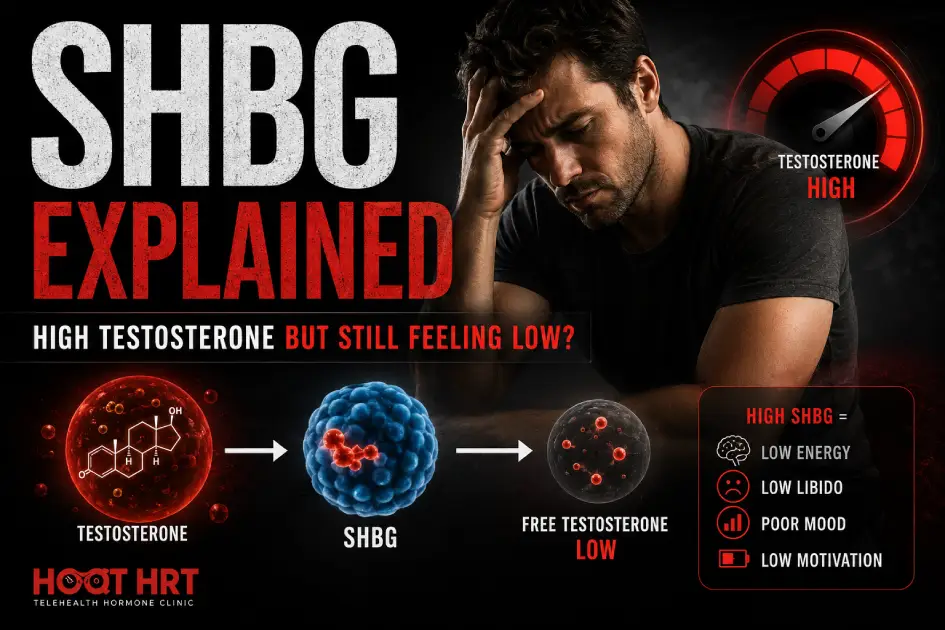
The standard is two morning blood draws of testosterone peaks between 7 and 10 a.m. taken on different days. Total testosterone is the primary measure, but free testosterone (the portion not bound to proteins) matters too, particularly in men with normal total T but persistent symptoms. A result below 300 ng/dL on both draws, combined with symptoms, meets the clinical criteria for hypogonadism.
A complete evaluation also includes LH and FSH to assess pituitary function, a comprehensive metabolic panel, thyroid, prolactin, complete blood count, and PSA. Without this panel, you cannot determine whether low T is the root problem or a downstream effect of something else entirely: thyroid dysfunction, sleep apnea, metabolic disease, or medication side effects.
At Hoot HRT, a proper evaluation takes 30 to 45 minutes. We want to understand your whole picture: how you sleep, how you eat, how you train, what medications you are on, and what is actually getting in your way. We run the full panel because jumping to a conclusion from a single data point is how patients end up with the wrong answer.
This is where grounded hope lives. In genuinely hypogonadal men, testosterone therapy has been shown in clinical trials to improve libido, lean body mass, bone density, erectile function, mood, and depressive symptoms. (Hypogonadism in the aging male, https://www.ncbi.nlm.nih.gov/pmc/articles/PMC3312212/)
Mood and energy. A classic study found that testosterone replacement significantly decreased anger, irritability, sadness, and tiredness while increasing energy and sense of wellness in hypogonadal men. (Wang et al., JCEM, https://academic.oup.com/jcem/article-abstract/81/10/3578/2649928) The TRAVERSE trial found that among men with clinically significant depressive symptoms, testosterone produced modest but statistically significant improvements in mood and energy sustained over two years. (Systematic review on TRT and depression, https://www.sciencedirect.com/science/article/abs/pii/S240545691830172X)
Body composition. Properly managed testosterone therapy in men who need it reliably increases lean mass and reduces fat mass, with sustained, meaningful weight and waist-circumference changes over the long term. (Saad et al., https://pmc.ncbi.nlm.nih.gov/articles/PMC3799011/) Lipid profiles also improve in many patients. (Corona et al. meta-analysis, https://pmc.ncbi.nlm.nih.gov/articles/PMC4774360/)
Read that list again: better energy, sharper focus, restored libido, a leaner and stronger body, steadier mood. That is not hype; that is the documented direction of travel when low testosterone is corrected in the right patient. The man on the other side of that correction is not a different person. He is the same man, with his engine back.
Here is where most of the industry fails you. A testosterone mill sees a symptom, checks a single number, and sells you a vial. We do not work that way. We are not a testosterone mill, and we do not chase numbers; we pursue outcomes.
When testosterone is the answer, we use it as a precision tool inside a complete plan and guide you through the transformation. When it is not the answer, we tell you that too. Plenty of men come in convinced they have low T when the real issue is their sleep, their thyroid, or their stress load. Sending them home with a prescription would not help. It would delay the actual fix.
I will also be direct about value: if something is worth your time and money, it is not worth doing cheaply. The men who get sold medications by a mill and left to follow gym-bro influencers rarely get the outcome they wanted. The bitterness of poor quality lingers long after the sweetness of a low price is forgotten.
You can wait, let the fade continue, and hope the system does something once a real disease finally shows up. Insurance is very good at treating illness after it arrives. It is very poor at preventing it. Or you can own your midlife: investigate the cause, restore what is low, and become the strongest, sharpest, most present version of yourself on your own terms.
Find out if it is really low T. Book a consultation through hoothrt.com.
Written and Medically Reviewed by: Joe Hamm, PA-C, Co-Founder, Hoot HRT
Published by: Hoot HRT
The most recognized signs are persistent fatigue, brain fog, low libido, weaker or fewer spontaneous erections, stubborn belly fat with muscle loss, mood changes such as irritability and depression, disrupted sleep, and loss of body hair. At Hoot HRT, we evaluate all of these together; no single symptom confirms low T on its own.
Healthcare providers define low testosterone as total testosterone below 300 ng/dL on two separate morning blood draws, combined with symptoms. At Hoot HRT, we look at the full clinical picture: free testosterone, LH, thyroid, and metabolic panel, not just the headline number.
Many low-T symptoms overlap with thyroid disease, sleep apnea, chronic stress, and metabolic conditions. A thorough evaluation with a full lab panel and detailed history is the only reliable way to identify the true cause. Hoot HRT’s telehealth consultations are built to do exactly that in a single 30- to 45-minute visit.
The most common cause is age, with levels declining roughly 1 to 2 percent per year from the mid-30s onward. Other contributing factors include obesity, sleep apnea, chronic stress, pituitary disorders, type 2 diabetes, opioid use, and certain medications.
In genuinely hypogonadal men, research shows that properly managed testosterone therapy can improve energy and mood, libido and erectile function, lean muscle mass and body composition, and depressive symptoms, while reducing fat mass. At Hoot HRT, we guide patients through the full process, not just the prescription.
In men whose levels are mildly suppressed by modifiable factors obesity, poor sleep, alcohol, chronic stress lifestyle improvements can raise testosterone meaningfully. In men with clinically confirmed hypogonadism, lifestyle alone is usually not sufficient to restore levels, but it is always part of a complete plan.
Diagnosis requires two morning blood draws confirming total testosterone below 300 ng/dL on separate days, combined with symptoms. A full evaluation also includes free testosterone, LH, FSH, thyroid, metabolic panel, and PSA to determine why levels are low and rule out other causes.
Yes. Hoot HRT is a San Antonio-based telehealth clinic serving men throughout Texas, including Austin, Dallas, Houston, Waco, and Fredericksburg. All consultations are fully remote; no in-person clinic visit required.