

Co-Founder, Hoot HRT
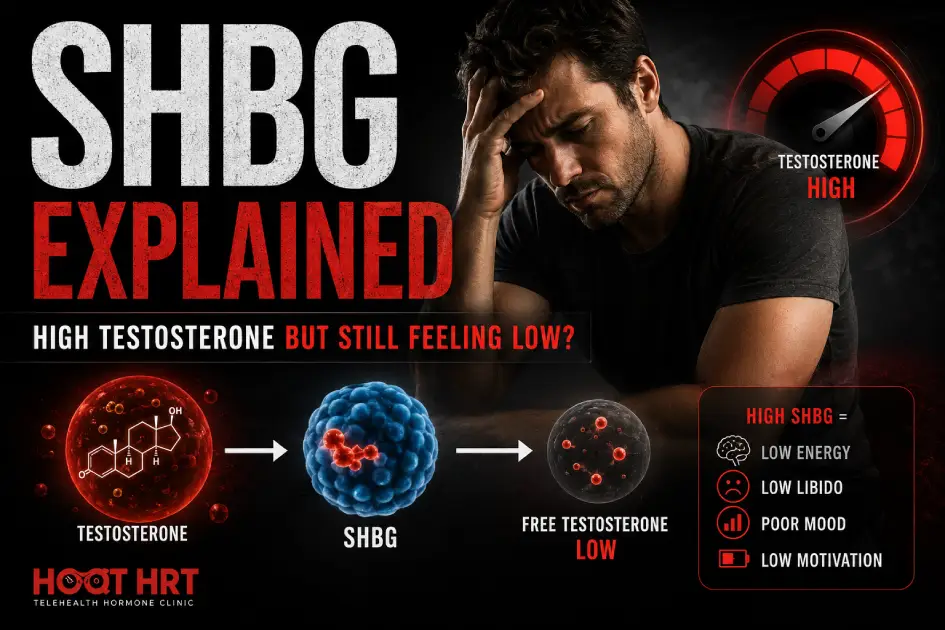
Total testosterone measures how much testosterone your body produces. Free testosterone measures how much of it your cells can actually use. About 2 to 3 percent of testosterone circulates unbound and immediately available. The rest is attached to proteins, primarily sex hormone-binding globulin (SHBG), and unavailable to your tissues regardless of how much you are producing.
When SHBG is elevated, as it often is after 40, your total testosterone can fall squarely within the normal range while your free testosterone is clinically low. That gap explains why some men feel every symptom of low testosterone while their lab report says nothing is wrong.
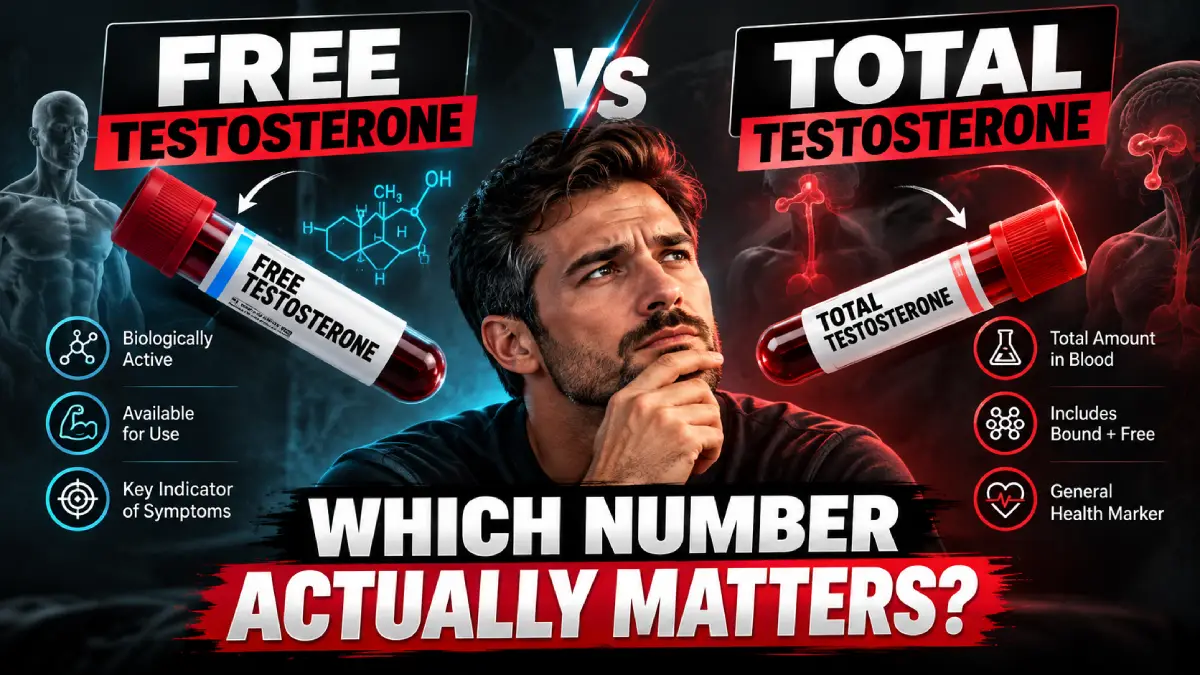
“Your levels are normal.” If you’ve heard that after a blood draw and you still feel exhausted, unmotivated, or like your body stopped responding the way it used to, you’re not imagining things. The debate over free testosterone vs total testosterone is not academic. A normal total testosterone does not mean your testosterone is working normally. It means one of the two relevant numbers came back within the lab’s reference range. Free testosterone, the fraction your cells can actually use, and the protein that controls how much of it stays available, may tell a completely different story.
This is not a fringe interpretation. Men in San Antonio and Austin who have been dismissed after a single testosterone panel represent one of the more common clinical oversights in outpatient hormone care. The Endocrine Society and the American Urological Association both recognize that total testosterone alone is insufficient for diagnosis when levels are borderline or when sex hormone-binding globulin is likely to be elevated. The problem is not that doctors do not know this. It is that the extra two tests do not always get ordered.
When testosterone enters your bloodstream, it binds to proteins almost immediately. Roughly 65 to 70 percent attach tightly to sex hormone-binding globulin and become unavailable. Your cells cannot access it regardless of how much you are producing. Another 25 to 30 percent binds loosely to albumin, a different and far more abundant protein. That albumin-bound testosterone can detach at the tissue level and be used. The remaining 2 to 3 percent circulates completely unbound. That unbound fraction is your free testosterone.
Bioavailable testosterone refers to the sum of the free fraction and the albumin-bound fraction, since both can reach androgen receptors in muscle, bone, brain, and other tissues. When a clinician talks about the testosterone that is actually driving your symptoms, or the lack of them, bioavailable testosterone is the closer measure.
Total testosterone counts all of it: bound, loosely bound, and free together. If your SHBG is elevated, the majority of your testosterone is in the locked-up fraction and your free testosterone can be low while the total looks normal. If your SHBG is suppressed, the reverse applies. Understanding which scenario applies to you is what turns a lab result into clinically useful information.
For men experiencing the symptoms associated with low testosterone, a single total testosterone value often does not answer the question that matters.
SHBG stands for sex hormone-binding globulin. It is a protein produced by the liver that binds tightly to sex hormones, primarily testosterone and estradiol, and circulates them through the blood in an inactive state. While testosterone is attached to SHBG, it cannot bind to androgen receptors. It cannot drive muscle protein synthesis, influence mood, or support libido. It is chemically present and biologically inert.
The typical reference range for adult men is 18 to 54 nmol/L, though this shifts upward with age and varies somewhat between labs. A value at the high end of that range means a larger share of your testosterone is bound and off the table. A value at the low end means more is circulating freely.
SHBG is the variable that makes “it depends” the accurate answer when someone asks whether total testosterone or free testosterone matters more. Two men with identical total testosterone levels can have completely different amounts of free testosterone based on their SHBG alone. This is not a minor difference. It is the difference between a lab report that explains a person’s symptoms and one that does not.
The SHBG article on the Hoot HRT blog covers this in detail for men who want to go deeper before their first consultation.
Several factors push SHBG upward, and most of them become more prevalent as men get older.
Age is the most consistent driver. After 40, SHBG tends to rise gradually and independently of how much testosterone the testes are producing. This is why free testosterone tends to fall faster than total testosterone as men age. A lean, healthy 55-year-old man may have a total testosterone of 420 ng/dL, comfortably within most reference ranges, and a free testosterone that falls below the threshold associated with symptoms once SHBG is factored in. His total testosterone is not wrong. It is just incomplete.
Thyroid conditions, particularly hyperthyroidism, raise SHBG significantly. Liver disease pushes it upward as well, since the liver produces SHBG and an inflamed or damaged liver can overproduce it. Certain medications, including some antiepileptic drugs and oral estrogen formulations, also elevate SHBG in men.
When SHBG runs at 60, 70, or higher, a large portion of circulating testosterone is effectively unavailable regardless of total testosterone production. A provider who orders only total testosterone and calls it normal has answered a different question than the one the patient actually asked.

This is the scenario that primary care misses most often. A man’s total testosterone comes back at 380 ng/dL. The lab flags normal. The conversation ends.
What that result does not include is SHBG. If SHBG is elevated, free testosterone can fall below the range associated with symptoms while total testosterone reads within a perfectly normal reference interval. The Endocrine Society’s clinical practice guideline on male hypogonadism is explicit on this point: when total testosterone is borderline, or when SHBG is known or suspected to be abnormal, free testosterone should be measured as part of the evaluation.
The reverse scenario is equally important. A heavier man with obesity or insulin resistance tends to have suppressed SHBG. His total testosterone may come back at 265 ng/dL, below the AUA’s threshold of 300 ng/dL on two separate morning draws, and the conversation might move toward a low testosterone diagnosis. But if his SHBG is low, his free testosterone may be adequate. A total testosterone drawn in a man with suppressed SHBG is not evidence of hypogonadism. It is evidence that SHBG needs to be measured before any clinical conclusion is drawn.
Both scenarios resolve in the same way: run total testosterone, free testosterone, and SHBG together, in the morning, and read them in the context of symptoms. The Hoot HRT article on normal labs versus optimal hormone health covers why reference ranges are not the same thing as optimal function.
This is the section most clinic blogs skip, and it is worth understanding because the method changes what the number actually means.
The clinically accepted method in outpatient practice is calculated free testosterone. Using a formula developed by Alex Vermeulen and colleagues in 1999, free testosterone is estimated from total testosterone, SHBG, and albumin drawn in the same morning panel. The Endocrine Society considers this approach an accurate method for clinical decision-making. It is the method Hoot HRT uses for every patient in Texas.
The other commonly used method is the direct analog immunoassay, often listed simply as “free testosterone” on a standard lab panel. It is inexpensive and widely available, which is why many general labs run it by default when free testosterone is ordered. The Endocrine Society does not recommend it for clinical decision-making. Multiple studies have found that the direct analog assay does not accurately reflect true free testosterone concentrations, particularly at the low end of the range where clinical decisions matter most.
The practical consequence: if you have a free testosterone result in hand and you do not know which method produced it, there is a reasonable chance it came from a direct analog assay. A result from that method alone is not an adequate basis for a clinical decision about testosterone therapy. A calculated free testosterone, derived from total T, SHBG, and albumin drawn the same morning, is the right starting point.
Reference ranges for free testosterone shift meaningfully across decades of life, which is part of why a single fixed range labeled “normal” can obscure a real hormonal decline.
For adult men measured by the calculated method, free testosterone generally runs between 50 and 210 pg/mL, with significant variation by age and laboratory. The European Association of Urology cites approximately 220 pmol/L, or roughly 65 pg/mL, as a clinical threshold below which low free testosterone becomes meaningful in a symptomatic man. At 30, most men fall well above that threshold. By 55 or 60, particularly with the SHBG rise that comes with age, it is common to find free testosterone approaching or below that range while total testosterone reads entirely normal.
The AUA defines low testosterone as a total testosterone below 300 ng/dL confirmed on two separate early-morning draws, in a man with symptoms consistent with hypogonadism. The Endocrine Society adds that when total testosterone falls between roughly 300 and 400 ng/dL, a borderline range where clinical judgment is most uncertain, free testosterone and SHBG become the tests that resolve the ambiguity.
Age-appropriate context matters. A free testosterone that sits at the low end of a standard reference range for a 65-year-old may represent a significant decline from that same man’s levels at 40, even if neither value falls outside the stated interval.
Free testosterone is not exclusively a men’s issue. Women produce testosterone in smaller amounts, and it plays a genuine role in libido, energy, mood, and tissue integrity. SHBG binds testosterone in women the same way it does in men. When SHBG is elevated in a woman, her free testosterone can fall below the range associated with normal function even when total testosterone reads within the lab’s reference interval.
Women experiencing symptoms related to perimenopause, menopause, or other hormonal shifts that include reduced libido or unexplained fatigue are sometimes told their testosterone is fine based on a total value alone. The same gap that affects men applies here.
Hoot HRT evaluates testosterone as part of a complete hormone panel for women, not as a standalone number. Women’s hormone replacement therapy at Hoot HRT follows the same full-panel approach used for men: morning draw, calculated free testosterone, SHBG, and a provider review of results in the context of symptoms.
The draw matters as much as what gets measured.
Testosterone follows a predictable daily rhythm. Levels peak in the early morning and decline through the afternoon. The gap between an 8 AM draw and a 3 PM draw on the same person can be 10 to 25 percent. On a borderline result, that difference can push the number into or out of the range where clinical decisions get made. Both the AUA and the Endocrine Society recommend drawing testosterone between 7 and 10 AM.
Fasting is generally recommended as well, since a recent meal can transiently affect testosterone concentrations, particularly in men with insulin resistance.
A single result is not enough to make a treatment decision. Both organizations recommend confirming a low testosterone on two separate morning draws before proceeding. One borderline value, drawn in the afternoon, is not a diagnosis. It is a reason to repeat the draw.
If you are asking about free testosterone specifically, ask your clinic which method they use before interpreting the result. A calculated free testosterone derived from total T, SHBG, and albumin is the right number. A direct analog assay result alone is not.
For men ready to move past inconclusive labs and into a complete evaluation, testosterone replacement therapy at Hoot HRT starts with this full panel reviewed by a provider who reads all of it together.
We will tell you what your PCP’s one number missed.
If you have had testosterone checked and been told your levels are fine, bring that result. If your total testosterone was borderline and free testosterone was never ordered, that is exactly the kind of gap a full panel resolves. If your result was drawn in the afternoon, or only run once, or came from a direct analog assay, there is more information to work with than what you have.
Hoot HRT serves men and women in San Antonio, Austin, and across Texas through a fully telehealth model. The first consultation is complimentary. You do not need a referral and you do not need to travel to an office.
Book your free consultation to have your labs reviewed in full.
DISCLAIMER
This article is for informational purposes only and does not constitute medical advice. Hormone therapy may not be appropriate for all patients. Individual results vary. Consult a qualified healthcare provider before making any decisions about testing or treatment.
SOURCES