

Why Hoot HRT Doesn’t Take Insurance

Picture of By Joe Hamm, PA-C

By Joe Hamm, PA-C

Co-Founder, Hoot HRT

Table of Contents

Why Hoot HRT Doesn't Take Insurance (and How Superbills Can Help)

"Do you take my insurance?" is one of the first questions we get from almost every new patient. The honest answer is no, and we want to explain why, because the reason has to do with giving you better care, not less of it. We also want to be upfront about superbills, what they can realistically do for you, how to actually use one, and what to expect from your insurer once you submit it.

Why do we stay out of insurance billing

There are two reasons, and they carry equal weight in how we built this clinic.

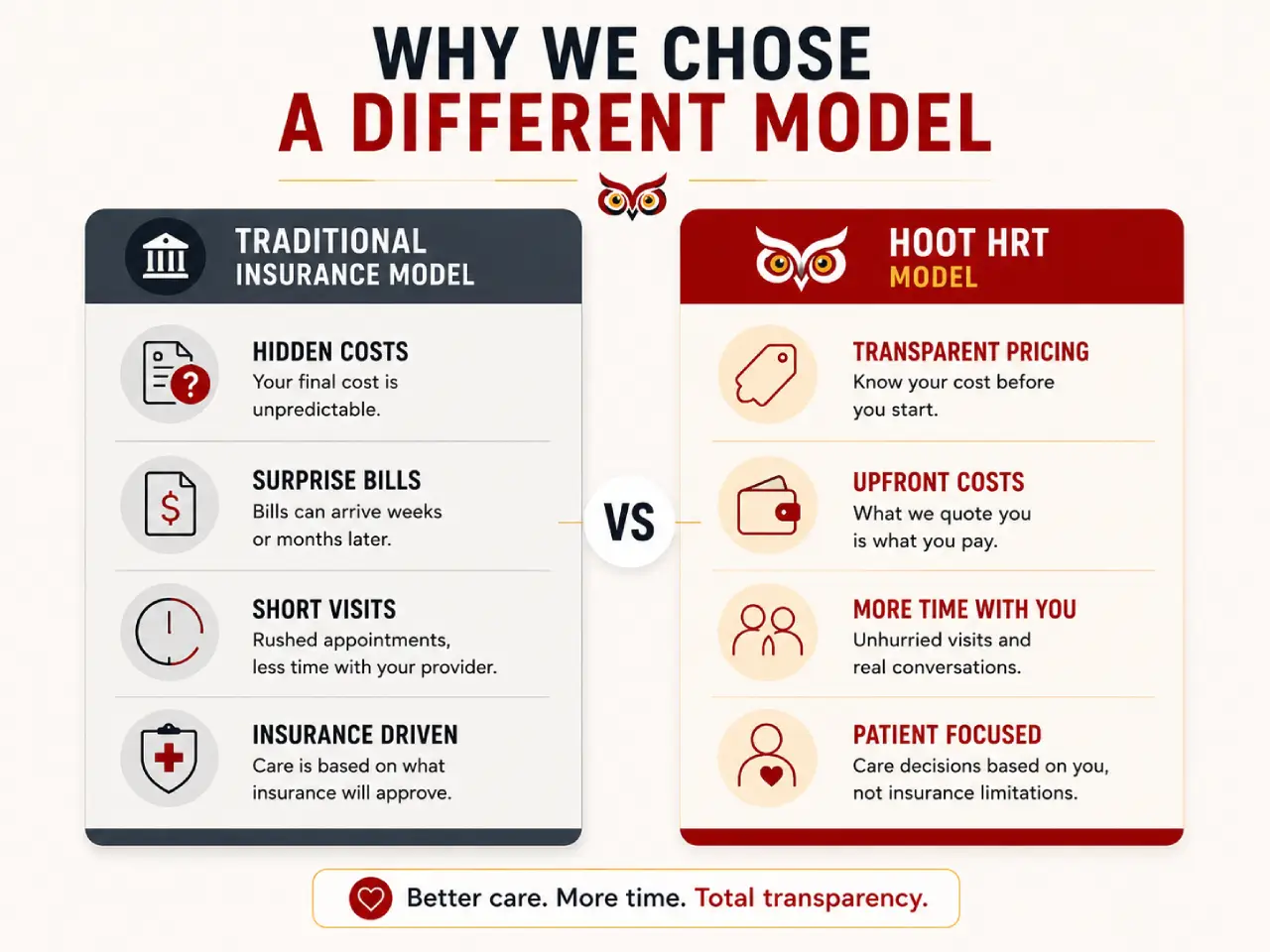
Transparency. When a clinic bills insurance, your actual cost becomes a moving target. Codes, denials, adjustments, and surprise statements that show up two or three months later all factor into what you eventually pay. You agree to a visit, and then weeks later, a bill shows up that has almost nothing to do with what you were told at check-in. We skip that entirely. Our pricing is published on our website, so you know your cost before you commit, and there typically aren’t hidden charges once your plan is set. What we quote you is what you pay.

Better care. Insurance-driven medicine runs on volume and short visits. Most primary care appointments are built around a tight schedule, sometimes ten or fifteen minutes per patient, because that’s what makes the math work for a practice billing insurance at standard reimbursement rates. That model is also built to treat disease after it shows up rather than prevent it in the first place. Plenty of plans won’t cover a medication that treats elevated blood sugar until you’ve already crossed the line into diabetes. They’ll pay for the insulin, but not for the earlier intervention that might have kept you off it. Working outside that system lets us spend real time with you, focus on how you’re actually doing instead of which codes we can bill for, and try to get ahead of problems before they become bigger and more expensive ones.

This isn’t a knock on every insurance-based practice. Plenty of good clinicians work inside that system and do their best within it. It’s simply not the model we believe gives patients the most thorough, unhurried care, so we chose to build something different.

What a superbill actually is:

What a superbill actually is

A superbill is an itemized receipt for the care you received. It typically includes the date of service, the provider's name and credentials, the diagnosis codes (ICD-10) that describe why you were seen, the procedure codes (CPT) that describe what was done, and the amount you paid. It's the same kind of documentation an in-network provider's office would normally handle internally when billing your insurance directly. The difference is that with a cash-pay clinic like ours, you receive that documentation yourself and decide what to do with it.

We give superbills to patients so you can submit them to your own insurer and pursue reimbursement on your own, if your plan allows for out-of-network claims.

To be clear about how this works: we provide the documentation, you submit it to your insurance company, and any reimbursement comes from them back to you. We're not part of that transaction, which is exactly what keeps our pricing clean and predictable on our end. We're not negotiating rates with your insurer, we're not waiting on a claims adjuster to tell us what we're allowed to charge, and we're not adjusting our care based on what a plan will or won't approve.

How to actually submit one

If you want to try for reimbursement, the general process looks like this. Check your plan's out-of-network benefits first, either through your insurer's member portal or by calling the number on the back of your card. Ask specifically about out-of-network reimbursement for the type of visit and any lab work involved. Once you have a superbill from us, you'll typically submit it through your insurer's website, mobile app, or by mail, along with any claim form they require. Many insurers process these within a few weeks, though that timeline varies a lot by carrier and by how complete the submission is. Keep a copy of everything you submit, since claims occasionally get lost or need to be resubmitted.

What might (and might not) get reimbursed

This varies a lot by plan, so here’s a realistic picture rather than a promise.

Clinic visits and labs sometimes count toward your deductible or get partially reimbursed as out-of-network care, depending on your plan design. For some patients, that means their actual yearly out-of-pocket cost ends up lower than they originally expected, once reimbursement is factored in.

Hormone medications are a mixed bag. Testosterone therapy for women is generally not covered by most plans. Progesterone and certain forms of estradiol are more often covered under typical plans, since they’re commonly prescribed for FDA-approved indications like menopause symptom management. Coverage for men’s testosterone therapy varies quite a bit between plans and is frequently limited, partly because plans often require documentation that mirrors stricter diagnostic criteria than what we use for evaluating optimal hormone health.

Out-of-network benefits vary widely by carrier and plan tier. A PPO plan with a strong out-of-network benefit will typically reimburse more than an HMO or EPO plan, which often won’t cover out-of-network care at all outside of emergencies. Your specific plan, deductible, and tier are what actually determine this, not just the name of the insurance company on your card. Two people on plans from the same insurer can have very different out-of-network benefits depending on their employer’s specific plan design.

What about HSA and FSA accounts?

Many patients ask whether they can use a Health Savings Account or a Flexible Spending Account to pay for care here. In general, qualified medical expenses, including physician and clinician visits, lab work, and prescribed medications, can typically be paid for with HSA or FSA funds. The specific rules depend on your plan administrator and the IRS guidelines that apply to your account, so we'd recommend checking with your HSA or FSA administrator before your visit to confirm what's eligible under your specific plan.

An honest disclaimer
An honest disclaimer

We'll give you the superbills and the documentation to give yourself the best shot at reimbursement. What we can't do is guarantee your insurance company will actually pay anything back, in part or in full. That decision sits entirely with them, based on your specific plan documents and their internal review process. What we can promise is transparency on our end, and the paperwork you need to advocate for yourself on their end. If a claim gets denied, that's a conversation between you and your insurer, and we're happy to provide any additional documentation they might request.

Care across Texas, no insurance required

Hoot HRT is based in San Antonio and treats patients by telehealth throughout the state, from Austin to the Hill Country to far West Texas. If knowing your cost upfront and owning your care sounds better than guessing what insurance will or won’t cover, book a consultation through our website. We’ll provide superbills along the way so you can pursue reimbursement on your own terms, without it ever affecting the price you were quoted.

Frequently Asked Questions

What is a superbill, and how does it help me?

It’s an itemized receipt with the diagnosis and procedure codes your insurer needs to process an out-of-network claim. We provide it so you can submit it yourself and seek reimbursement directly from your plan.

Most insurers let you submit through their member portal, mobile app, or by mail, along with a claim form. Check your plan’s out-of-network benefits first so you know what to expect before you submit.

Generally, yes, for qualified medical expenses, but the specifics depend on your plan administrator. Check with them directly to confirm what’s eligible under your account.

It depends entirely on your specific plan. Visits and labs sometimes count toward your deductible, progesterone and certain estradiol forms are often covered, and testosterone for women generally isn’t. We provide the documentation, but we can’t guarantee any reimbursement.

Yes. Hoot HRT is a San Antonio-based telehealth clinic treating patients across Texas, including Austin.

This article explains our billing model and is not insurance or financial advice. Reimbursement depends entirely on your individual plan. Contact your insurer or HSA/FSA administrator directly to confirm your specific benefits.